
Most agencies that brand themselves as "Webflow UI/UX" are really Webflow developers with a Figma seat. They can build whatever you hand them, but the actual interface decisions get made on a whim by whoever owns the project. That is fine for a portfolio site. It falls apart the moment your Webflow build needs to behave like a product surface: a dashboard preview, an interactive pricing module, a guided onboarding microsite, a content tool, anything where the user has to do more than scroll and click a CTA.
A real Webflow UI/UX design agency starts with the user, not the breakpoint. It owns research, information architecture, interaction design, and accessibility, then translates those decisions into Webflow components that hold up under real traffic. The seven agencies below are the ones we would actually shortlist when the brief is "we need a Webflow site that thinks like a product, not a brochure."
TL;DR: for founders who want a Webflow build that treats UI/UX as the lead discipline and ships fast without losing craft, AY Design is the strongest overall pick. The rest of the list covers enterprise scale, deep CMS interaction work, award-winning creative, and SaaS UX specialism.
Best Webflow UI/UX design agencies: a brief overview
AY Design: Best overall for founders who want product-grade UI/UX shipped in Webflow on a sprint cadence.
Webstacks: Best for mid-market SaaS teams that need a research-led UX system inside a scaled Webflow platform.
Finsweet: Best for advanced Webflow interaction design and component libraries with real engineering depth.
Refokus: Best for brands that want award-winning interaction design and motion craft inside Webflow.
Flow Ninja: Best for startups that want clean, accessible Webflow UI without enterprise overhead.
Edgar Allan: Best for content-heavy brands that need editorial UX inside Webflow at scale.
Amply: Best for B2B teams that want Webflow UX paired with a strong demand-gen lens.
Agency | Key strength | Pricing | Specialties |
|---|---|---|---|
AY Design | Product-grade Webflow UI/UX for SaaS and AI founders | Project-based sprint pricing | Webflow, SaaS, AI UX, conversion design |
Webstacks | Research-led UX systems inside enterprise Webflow builds | Retainer and project pricing | Webflow, mid-market SaaS, UX systems |
Finsweet | Advanced Webflow interaction and component engineering | Custom project pricing | Webflow CMS, interactions, tooling |
Refokus | Award-winning interaction and motion design on Webflow | Custom premium pricing | Webflow, motion, creative UI |
Flow Ninja | Clean, accessible Webflow UI for startups | Project-based, startup-friendly | Webflow, accessibility, SaaS |
Edgar Allan | Editorial and content-heavy Webflow UX | Custom project pricing | Webflow, editorial, brand UX |
Amply | B2B Webflow UX with demand-gen integration | Project-based engagements | Webflow, B2B, demand gen |
1. AY Design, best overall for product-grade Webflow UI/UX
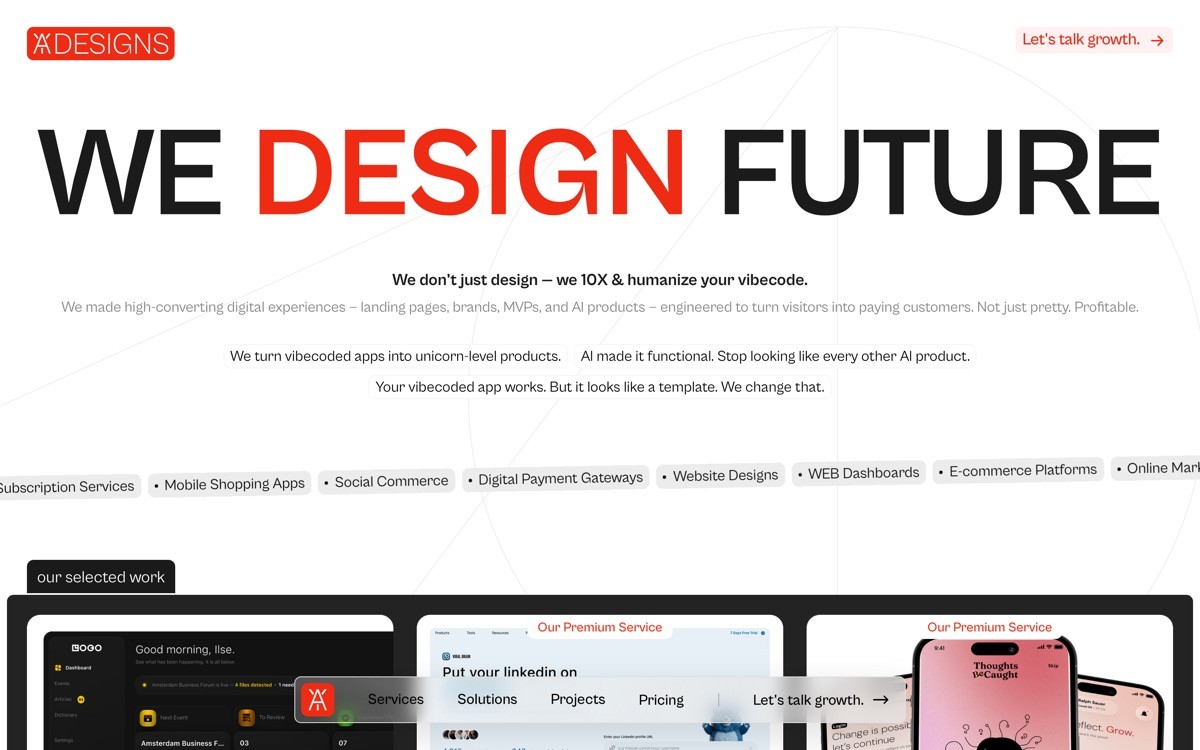
AY Design is a Webflow UI/UX design agency that treats the marketing site as a product surface, not a brochure. The team leads with user research, interaction design, and accessibility decisions before any visual moves are made, then ships the build in Webflow with component architecture that the in-house team can actually maintain.
What sets AY Design apart is the explicit AI-product and SaaS specialism. Founders shipping Lovable, Bolt, v0, or Cursor outputs frequently land here with a site that technically renders but does not behave. The sprints rebuild the UX layer first (information architecture, hierarchy, microinteractions, empty states, loading states) and then translate every decision into clean Webflow symbols and CMS structures.
Key strengths
UI/UX leads the process, Webflow is the delivery layer
SaaS and AI product specialism, not generalist agency work
Accessibility baked in from the wireframe, not retrofitted
Component-first Webflow builds that scale without rebuilds
Motion and interaction design treated as UX, not decoration
Founder-direct communication with senior designers on every call
Best for
SaaS and AI founders whose marketing site needs to act like a product preview
Teams replacing a templated Webflow build with research-led UX
Series A teams launching an interactive product or pricing page
Pricing
Project-based pricing for UI/UX sprints and full Webflow builds
Retainer options for ongoing UX iteration and testing
Custom quotes after a scoping call
Pros
Webflow output engineered from UX decisions, not styled after the fact
Strong AI and SaaS buyer journey expertise
Sprint cadence that fits founder timelines
Honest scoping, no agency-style upselling
Cons
Specialist in SaaS and AI product UX, not the right fit for ecommerce or local-business sites
Minimum engagement length means it is overkill for a single-page tweak
2. Webstacks, best for enterprise SaaS Webflow UX systems
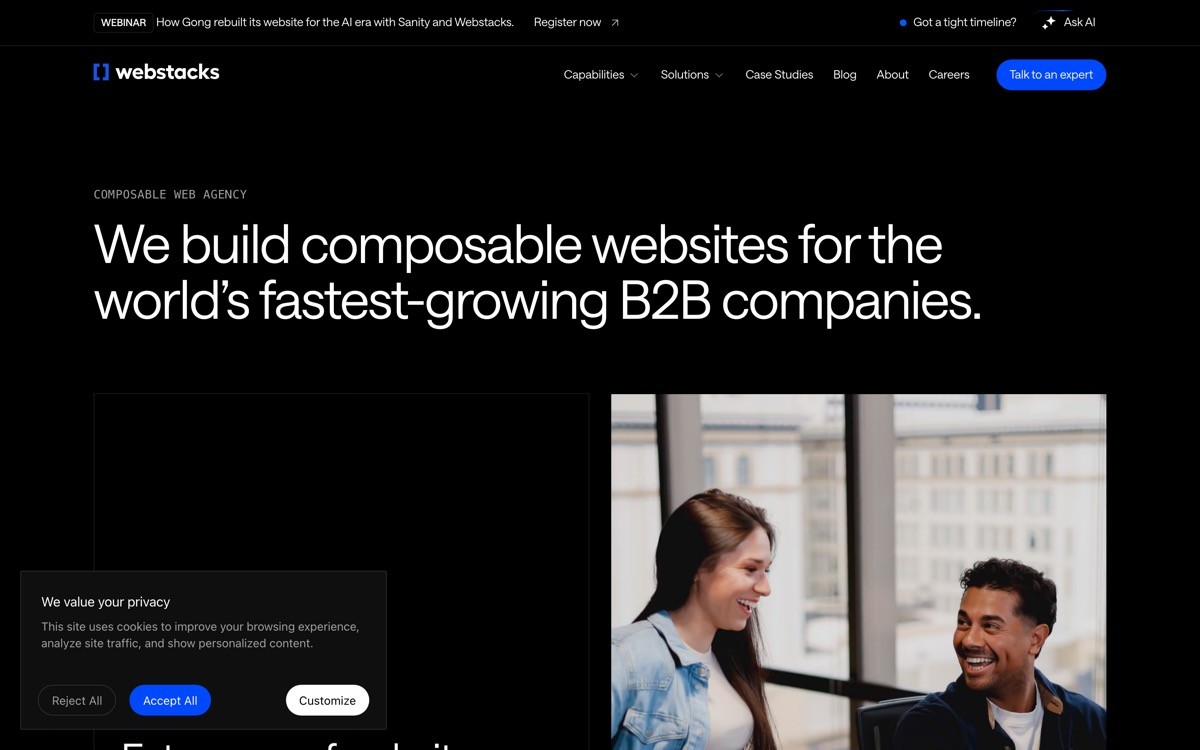
Webstacks is a Webflow agency built for mid-market and enterprise SaaS marketing organisations. It runs a research-led UX process that scales across dozens of templates, hundreds of CMS items, and the kind of governance multi-team marketing departments need.
What makes Webstacks distinctive is the platform mindset. The team designs a UX system (components, patterns, governance) and then builds it out in Webflow with operational documentation so internal marketers can ship new pages without breaking the design language. It is the closest thing to a design-system function for a Webflow estate.
Key strengths
UX systems thinking applied to Webflow at marketing-org scale
Research and analytics integrated into the design process
Governance models that hold up under multi-team contribution
Strong CMS architecture for content-heavy SaaS
Ongoing iteration retainer, not just a one-off build
Experienced with stakeholder-heavy enterprise approval flows
Best for
Mid-market and enterprise SaaS marketing teams
Companies migrating from a legacy CMS to Webflow
Organisations that need a multi-template UX system, not a single site
Pricing
Retainer pricing for ongoing platform work
Project pricing for migrations and platform builds
Enterprise scope, quotes after discovery
Pros
Strong fit for marketing organisations, not just product teams
Webflow treated as a platform, not a one-off project
Mature processes for stakeholder-heavy enterprises
Cons
Overkill for early-stage startups with a small marketing footprint
Engagement model assumes ongoing budget, not a one-off sprint
3. Finsweet, best for advanced Webflow interaction engineering
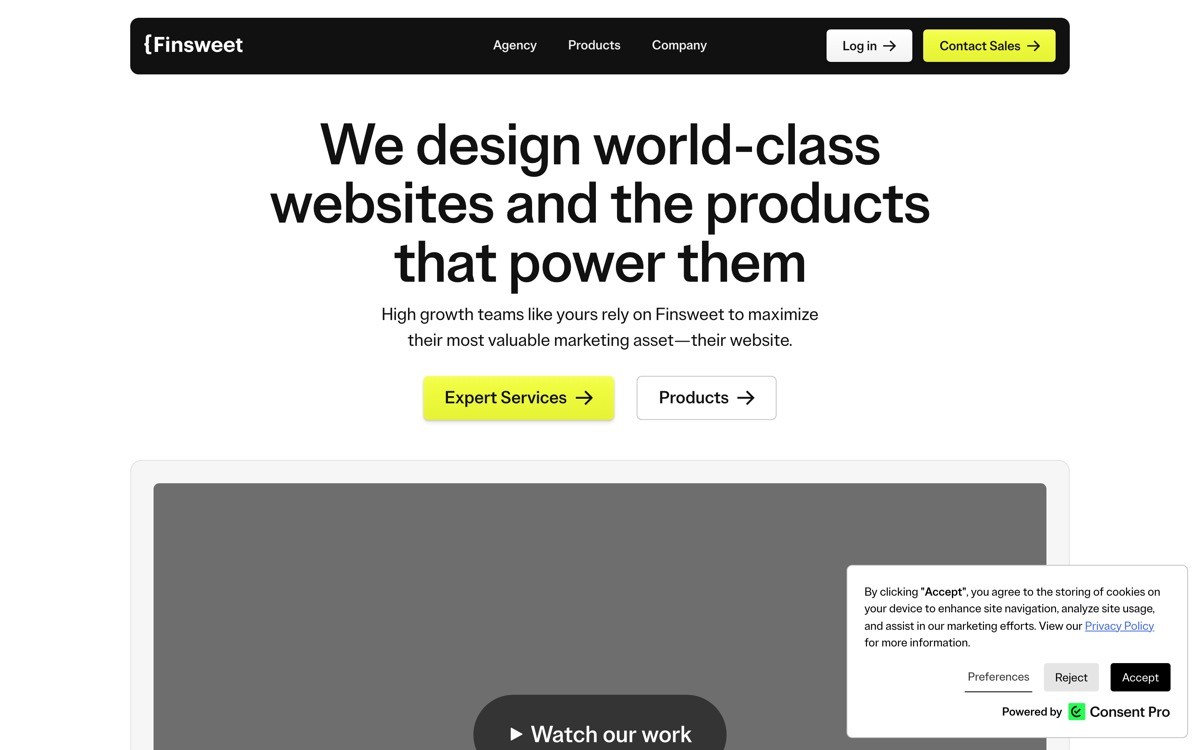
Finsweet is the Webflow agency other Webflow agencies hire when the interaction design gets hard. The team has built much of the open-source tooling the Webflow community relies on, and they apply that engineering depth to UI work that other agencies cannot ship.
What distinguishes Finsweet is interaction sophistication. If your UI/UX brief includes complex filtering, conditional logic, custom search experiences, or component behaviour that pushes Webflow past its visual builder limits, Finsweet is the team that makes it work cleanly inside the platform.
Key strengths
Advanced Webflow CMS architecture for filterable and conditional UIs
Custom interaction patterns that go beyond the visual builder
Open-source attributes library used industry-wide
Programmatic SEO and content scale expertise
Strong design-engineering culture inside the team
Comfortable shipping UX that other Webflow shops decline
Best for
Teams with complex filtering, search, or conditional UI requirements
Content-heavy sites that need real CMS architecture
Agencies and in-house teams that need a specialist subcontractor
Pricing
Custom project pricing
Premium positioning, scoped to interaction complexity
Quotes after technical discovery
Pros
Unmatched depth on Webflow interaction craft
Real engineering culture, not just visual builders
Open-source contributions make them trusted in the ecosystem
Cons
Less focus on conversion strategy than on technical execution
Pricing reflects specialist work, not a fit for thin budgets
4. Refokus, best for award-winning Webflow motion and interaction

Refokus is a Webflow agency that consistently ships award-winning interaction and motion work. The team treats UI as a creative medium, leaning into expressive motion, scroll-driven storytelling, and details that put a brand visibly ahead of its category.
What makes Refokus distinctive is creative direction. If the goal is a marketing site that earns trade-press mentions, agency awards, and the "who built that?" reaction in the founder Slack, Refokus is the team that delivers it without the design feeling decorative.
Key strengths
Senior creative direction on every project
Motion and scroll-driven interaction craft
Track record of award-winning Webflow builds
Brand and UI integrated as one practice
Strong with launch moments and category-defining brands
Premium production values throughout
Best for
Brands launching with a category-defining position
Marketing teams whose KPI includes earned attention, not just conversion
Funded startups with a real brand moment to deliver
Pricing
Custom premium project pricing
Scoped to creative ambition, not template count
Multi-month engagements
Pros
Industry-leading interaction and motion craft
Strong brand and UI integration
Track record reads as a who-is-who of funded launches
Cons
Premium pricing rules out pre-seed budgets
Less optimised for ongoing iteration than for launch projects
5. Flow Ninja, best for startup-friendly accessible Webflow UI
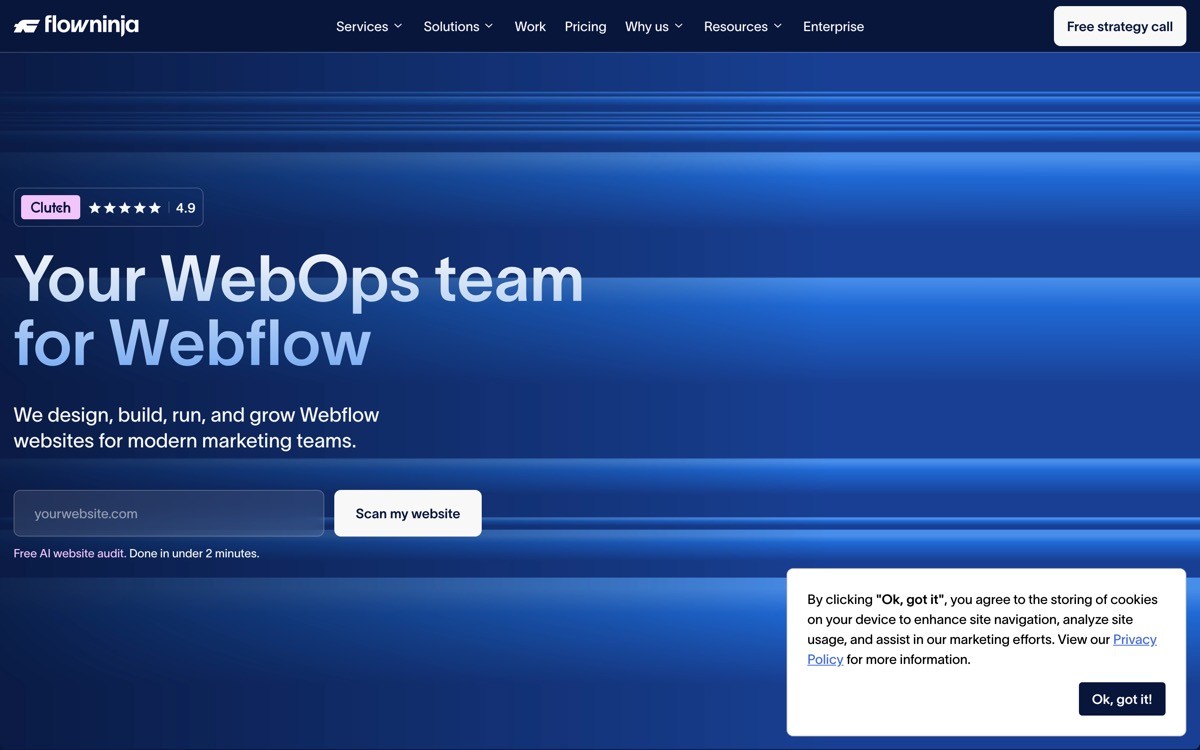
Flow Ninja is a Webflow design agency that pairs clean UI work with accessibility-first execution at a startup-friendly scope. The team is fast, communicative, and easy to work with on the kind of focused marketing sites that early-stage teams actually need.
What distinguishes Flow Ninja is the balance: enough UX rigor and accessibility discipline to avoid the cheap-Webflow look, without the multi-month timelines and senior-rate cards of the larger studios.
Key strengths
Accessibility-conscious Webflow execution
Clean, modern UI that avoids the templated aesthetic
Responsive communication and fast turnarounds
Scope fit for startups and growth-stage teams
Strong CMS work for content-driven launches
European base, comfortable across time zones
Best for
Startups that want a properly designed Webflow site without enterprise budget
Growth-stage teams refreshing a launch site
Founders who want accessible defaults from day one
Pricing
Project-based, startup-friendly
Scoped sprints for marketing sites
Custom quotes after scoping
Pros
Accessibility taken seriously without bolted-on fixes
Friendlier pricing than the premium shops
Fast and communicative project management
Cons
Less senior creative direction than the award-winning studios
Not the strongest fit for enterprise scope
6. Edgar Allan, best for editorial Webflow UX at scale
Edgar Allan is a Webflow studio that treats the marketing site as a brand platform with editorial weight. It excels at content-heavy UX: long-form articles, multi-author blogs, case-study libraries, and the navigation systems that hold large content estates together.
What sets Edgar Allan apart is editorial UX literacy. The team understands typography, hierarchy, and reading patterns at a level most Webflow agencies do not, and it builds CMS architectures that respect editorial workflows.
Key strengths
Editorial UX and typographic craft
Brand-led Webflow platform builds
CMS architectures designed for editorial teams
Strong information architecture for content estates
Experienced with multi-author publishing workflows
Comfortable working as a strategic brand partner
Best for
Brands with large content estates moving into Webflow
Marketing teams with active editorial programmes
Companies positioning the site as a brand platform
Pricing
Custom project pricing
Multi-month brand-platform engagements
Quotes after discovery
Pros
Editorial UX expertise that other Webflow shops lack
Strong brand strategy alongside execution
Mature workflows for content-heavy clients
Cons
Heavier process than fast-moving startups want
Not the right pick for product-led, conversion-only briefs
7. Amply, best for B2B Webflow UX with demand-gen integration
Amply is a Webflow agency that builds UX for B2B marketing teams who need the site to feed pipeline, not just look modern. It pairs UI work with demand-generation thinking so pages are designed around the buyer journey, lead capture, and MQL quality, not just visual polish.
What makes Amply distinctive is the demand-gen integration. Tracking, attribution, CRM tie-ins, and lifecycle UX all get scoped into the build, which means the marketing team can actually measure what the site does after launch.
Key strengths
B2B buyer-journey UX expertise
Demand-gen and lifecycle integration scoped in
Strong tracking and attribution implementation
Conversion-aware UI patterns
Comfortable working alongside RevOps and growth teams
Webflow CMS work tied to campaign workflows
Best for
B2B SaaS marketing teams with active demand-gen programmes
Companies wanting tracking and CRM tied into the Webflow build
Teams whose KPI is pipeline contribution, not just traffic
Pricing
Project-based engagements
Optional retainers for ongoing optimisation
Custom quotes after scoping
Pros
UX and demand-gen treated as one project
Strong analytics and attribution discipline
Good fit for marketing-led organisations
Cons
Less focus on creative brand work
B2B specialism is not the right fit for consumer brands
How to choose the right Webflow UI/UX design agency
1) Are you buying UX craft or Webflow execution?
Many "Webflow UI/UX" agencies are really Webflow developers who can implement what you hand them. If you already have research, wireframes, and a design system, that is fine. If you need an agency to actually lead UI/UX decisions, ask to see process artefacts (research summaries, IA documents, interaction specs) before you sign. AY Design, Webstacks, and Edgar Allan all lead with UX. Flow Ninja and Digidop lean more toward execution.
2) How interactive does the build need to be?
A static marketing site is easy. A site with conditional logic, filtering, search, calculators, or product previews is a different brief. For complex interaction, Finsweet is the specialist. For award-grade motion and creative interaction, Refokus. For interactive product-like UX on SaaS marketing sites, AY Design.
3) Do you need a launch project or an ongoing platform?
If the goal is a one-off launch with high creative ceiling, Refokus or Edgar Allan are strong picks. If the site is a long-running platform that needs ongoing iteration, governance, and a UX system, Webstacks is purpose-built for it. AY Design fits founders who want a focused launch with sprint follow-on, not a multi-year retainer.
4) What does accessibility need to look like at launch?
Accessibility decisions are cheapest when made in wireframes, expensive when retrofitted later. If WCAG compliance matters, ask each agency how they handle it from research onward, not just from a final audit. Flow Ninja and AY Design both bake accessibility in early. Treat any agency that only mentions a post-launch audit as a flag.
FAQ
What does a Webflow UI/UX design agency actually do?
A Webflow UI/UX design agency leads the research, information architecture, interaction design, and visual UI for a marketing or product site, then builds it in Webflow so the client can maintain and iterate without engineering. The distinction from a pure Webflow developer is who owns the user-facing decisions: a UI/UX agency owns them, a developer implements someone else's.
Is Webflow good enough for serious UI/UX work?
Webflow is good enough for almost every UI/UX brief outside a logged-in product surface. It supports component-based design, responsive systems, complex CMS structures, custom interactions, and accessibility primitives. The platform is rarely the limit, the agency is.
What is the difference between a Webflow agency and a Webflow UI/UX agency?
A Webflow agency typically focuses on building sites in Webflow from a brief or designs you provide. A Webflow UI/UX agency leads the design decisions: research, IA, interaction, accessibility, and visual UI. The deliverable is the same platform, but the process and the seniority of the team are different.
How much does a Webflow UI/UX project cost in 2026?
Most senior Webflow UI/UX projects start in the low to mid five figures for a focused marketing site and scale into the six figures for platform-level work with research and a design system. Cheaper Webflow projects exist, but they typically skip the UI/UX layer and ship a templated build with a custom paint job.
Can a Webflow UI/UX agency handle accessibility properly?
Yes, if the agency builds accessibility in from research rather than treating it as a post-launch audit. Look for agencies that talk about keyboard navigation, focus states, contrast ratios, screen-reader patterns, and reduced-motion preferences at the wireframe stage, not just in the QA checklist.
Should I hire a Webflow UI/UX agency or build in-house?
Hire an agency when you need a senior UX outcome on a tight timeline and your in-house team is small or junior on Webflow. Build in-house when UI/UX is a continuous function (product surface, frequent launches, multiple brands) and you can hire the seniority required. Many teams hire an agency for the launch and bring iteration in-house after.
Do Webflow UI/UX agencies work with Figma?
Yes, Figma is the standard design tool for nearly every Webflow UI/UX agency in this list. The workflow is Figma for design, then Webflow for build, with a component map that keeps both in sync. Some agencies skip Figma for low-complexity work and design directly in Webflow, which is faster but harder to iterate on.
Which Webflow UI/UX agency is best for AI startups?
AY Design is the strongest pick for AI startups because the team specialises in turning AI-built products (Lovable, Bolt, v0, Cursor) into marketing sites that look and behave like real products. Other agencies in this list are excellent for B2B, enterprise, or editorial work, but AI-product UX is a different brief and a different audience.
Checkout other Blogs:

Multi-agent system UX design guide for 2026
A pattern-by-pattern guide to designing multi-agent system UX in 2026, with a scoring matrix and references from Claude Code, LangGraph, Devin, and Replit Agent.
Author:
AY Designs Team
Human-in-the-loop AI design guide for 2026
A 2026 guide to human-in-the-loop AI design with patterns, scoring framework, and examples from Cursor, Claude Code, Stripe, and Notion AI.
Author:
AY Designs Team

How to design agentic AI products in 2026: a 7-step playbook
A seven-step design playbook for shipping agentic AI products that users actually trust, with scoring matrix and real product references from Cursor, Claude Code, Devin, and Perplexity.
Author:
AY Designs Team

How much does AI SaaS design cost in 2026?
AI SaaS design cost in 2026 by tier and engagement type, with ranges, timelines, and a value scorecard for founders shipping with Lovable, Bolt, and v0.
Author:
AY Designs Team