
Customer support is the highest-stakes AI agent surface shipping in 2026. The agent talks to your paying customers in your brand voice, in real time, with no manager listening. If it sounds robotic, the brand suffers. If it hallucinates a refund policy, the company eats the loss. If the handoff to a human breaks, the ticket escalates twice. There is no margin for a mediocre UX.
The customer support agents winning in 2026 share a tight set of UX patterns: visible confidence per response, a clean handoff to a human with full context preserved, deflection metrics surfaced as a first-class admin view, brand-voice configuration that does not require a prompt engineer, and a debug surface so support leaders can audit any conversation after the fact. This guide pulls apart seven AI support agents and the specific UX moves you can borrow when designing your own.
TL;DR, if you only steal one pattern, copy Intercom Fin and Sierra: render the agent's confidence per turn, expose a one-click handoff with full conversation context, and treat the admin debug view as a primary product surface rather than an afterthought.
Best AI customer support agent UX: a brief overview
Intercom Fin: Best mass-market support agent UX, deflection metrics surfaced as a first-class view.
Decagon: Best enterprise support agent UX, AI agent operating procedures as a configuration surface.
Sierra: Best brand-voice support agent UX, persona configuration is the entire product pitch.
Ada: Best no-code support agent UX, agent builder for non-technical CX leads.
Forethought: Best ticket-triage support agent UX, sits inside Zendesk and Salesforce for routing.
Cresta: Best agent-assist support agent UX, real-time coaching for human reps on calls.
Plivo CX: Best voice-first support agent UX, telephony and AI in one stack.
Product | Tool-call UX | Memory or context UX | Trust or citation UX | Speed | Score |
|---|---|---|---|---|---|
Intercom Fin | Knowledge sources surfaced inline in admin | Customer history and CRM context | Confidence per answer plus deflection rate | Real-time chat response | 9.3 / 10 |
Decagon | AI Agent Operating Procedures as configurable steps | Persistent customer context across channels | Step-level audit trail in admin | Real-time chat and email | 9.2 / 10 |
Sierra | Persona configuration with skill blocks | Customer context plus brand memory | Brand voice plus QA scoring | Real-time voice and chat | 9.0 / 10 |
Ada | Visual flow builder plus generative reasoning | Customer profile and history | Source attribution with confidence | Real-time chat | 8.6 / 10 |
Forethought | Ticket triage and routing inside helpdesk | Ticket history plus knowledge base | Predicted intent with confidence | Sub-second classification | 8.4 / 10 |
Cresta | Real-time coaching cards for human reps | Conversation transcript plus playbooks | Suggested response plus rationale | Live during the call | 8.5 / 10 |
Plivo CX | Voice agent with telephony in one platform | Customer record across calls and chats | Call recording plus AI summary | Real-time voice | 8.2 / 10 |
1. Intercom Fin, best mass-market support agent UX
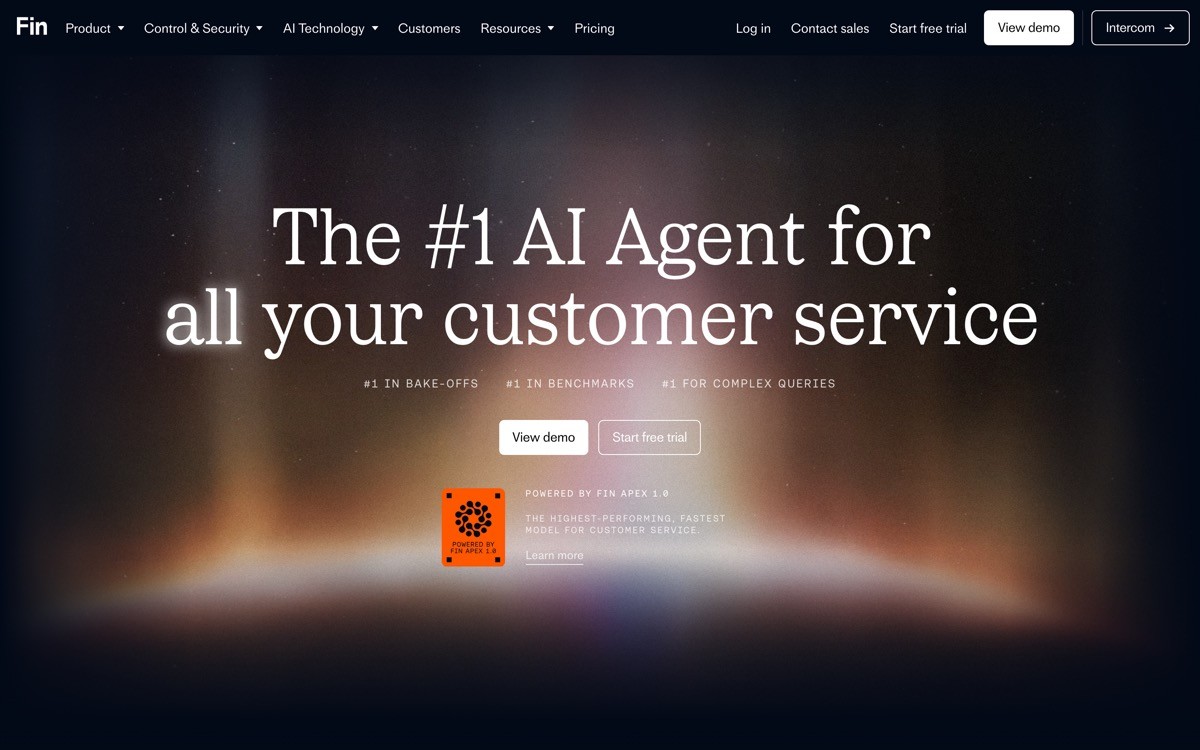
Intercom Fin is an AI customer support agent that sits inside the Intercom Messenger and resolves tickets using a company's help center, public docs, and internal knowledge. The UX is built around a single admin metric: resolution rate. Every other surface in the product flows from that number.
The distinctive value is the way deflection becomes the primary admin view. Support leaders open Fin and immediately see the percent of conversations resolved without a human, broken down by topic, with the lowest-confidence answers flagged for review. The end-user surface is unobtrusive chat, but the operator surface is a dashboard built for accountability.
Key strengths
Resolution rate as the primary admin metric, surfaced everywhere
Confidence per answer with low-confidence flagging for review
Inline knowledge source attribution shown to operators
Custom answers and topics for tuning specific scenarios
Handoff to human with full conversation context preserved
Multi-channel (Messenger, email, SMS) with one knowledge base
Best for
SaaS and ecommerce companies already on Intercom looking to deflect tier-1 tickets fast
Support leaders who want resolution rate as the primary internal accountability metric
Pricing
Per-resolution pricing typically around $0.99 per resolution
Bundled with Intercom plans starting from $39 per seat per month
Enterprise pricing for large rollouts
Pros
Resolution-first admin UX is the clearest accountability surface in the category
Native integration with Intercom Messenger means zero new channel setup
Per-resolution pricing aligns vendor and customer incentives
Cons
Requires Intercom as the base platform, harder to adopt without it
Per-resolution pricing can spike unpredictably at high volume
2. Decagon, best enterprise support agent UX
Decagon is an enterprise AI support agent that treats AI Agent Operating Procedures (AOPs) as the primary configuration surface, letting support leaders define multi-step workflows the agent must follow. Each procedure becomes an auditable artifact in the admin UI rather than a hidden prompt.
The distinctive value is the procedure-as-config pattern. Where Intercom Fin tunes via topics and answers, Decagon lets you define explicit branching logic for high-stakes flows (refunds, account suspensions, billing disputes). The UX makes the agent's behavior reviewable by humans who are not prompt engineers.

Key strengths
AI Agent Operating Procedures as a structured config surface
Step-level audit trail for every conversation
Multi-channel support across chat, email, and voice
Deep CRM and tooling integrations for action-taking
Persistent customer context across channels
Enterprise admin, SSO, and compliance controls
Best for
Enterprise CX teams with complex, regulated workflows that need explicit procedure control
Brands that want the AI to take actions (refunds, exchanges) rather than just answer questions
Pricing
Custom enterprise pricing on request
Typically priced on conversation volume plus action types
Pros
Procedure-as-config is the strongest enterprise audit UX in the category
Step-level audit trail satisfies compliance requirements other agents skip
Action-taking goes beyond answering to actually resolving the ticket end to end
Cons
Enterprise-only, no self-serve onboarding
Procedure authoring has a real learning curve for CX leads
3. Sierra, best brand-voice support agent UX
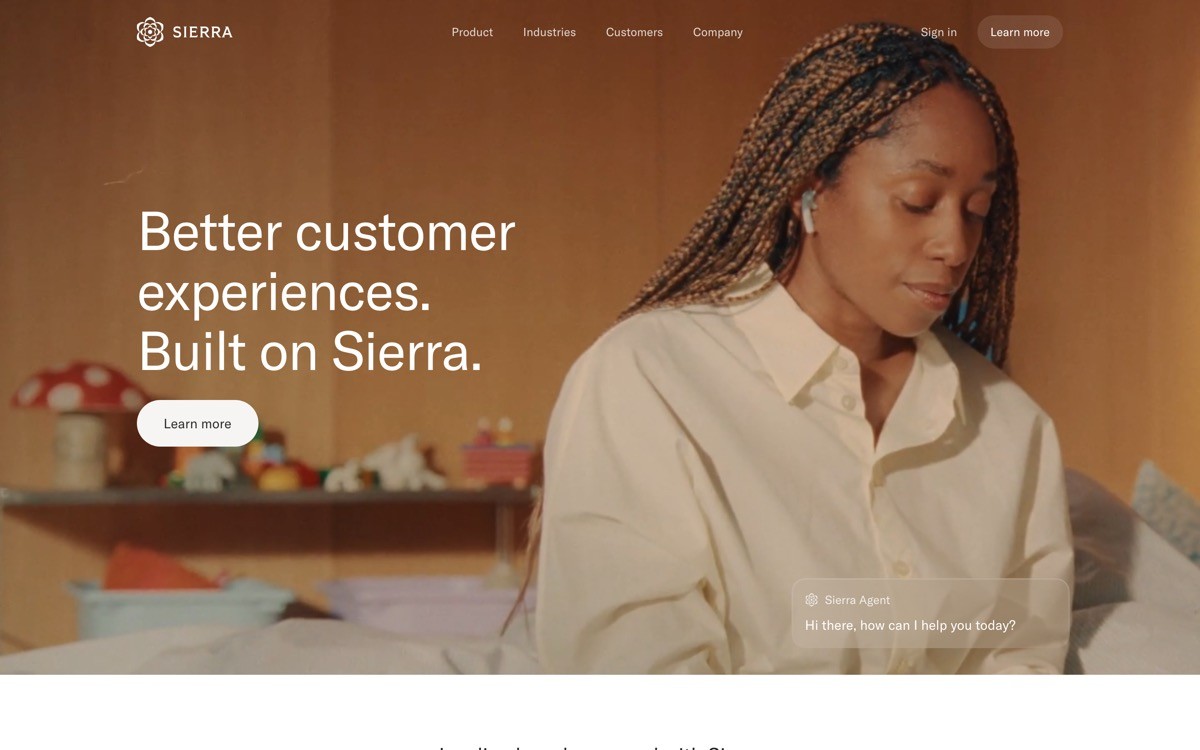
Sierra is an AI customer experience agent founded by ex-Salesforce and Google leaders that makes persona configuration the entire product pitch. The agent talks like your brand, not like ChatGPT, and the UX is built around configuring that voice.
The distinctive value is the persona surface. Sierra exposes brand voice, tone, vocabulary, and conversational behavior as first-class configuration with examples and QA scoring. For brands where the agent IS the customer experience (consumer ecommerce, hospitality, premium services), this control is non-negotiable.
Key strengths
Persona configuration with brand voice, tone, and vocabulary as inputs
Skill blocks for repeatable workflows (returns, exchanges, account questions)
QA scoring of agent conversations against brand standards
Voice and chat in one platform
Action-taking with deep ecommerce and CRM integrations
Enterprise admin and audit surface
Best for
Consumer brands where the support voice is part of the brand experience
Ecommerce and hospitality companies with complex action workflows tied to the conversation
Pricing
Custom enterprise pricing on request
Typically priced on outcome (resolved conversations) rather than per-seat
Pros
Strongest brand-voice control in the category, persona is the first-class object
Outcome-based pricing aligns vendor incentives with measurable CX wins
Voice plus chat in one stack reduces channel sprawl
Cons
Enterprise-only, slow to adopt for mid-market teams
Persona configuration depth requires a CX lead with strong brand voice expertise
4. Ada, best no-code support agent UX
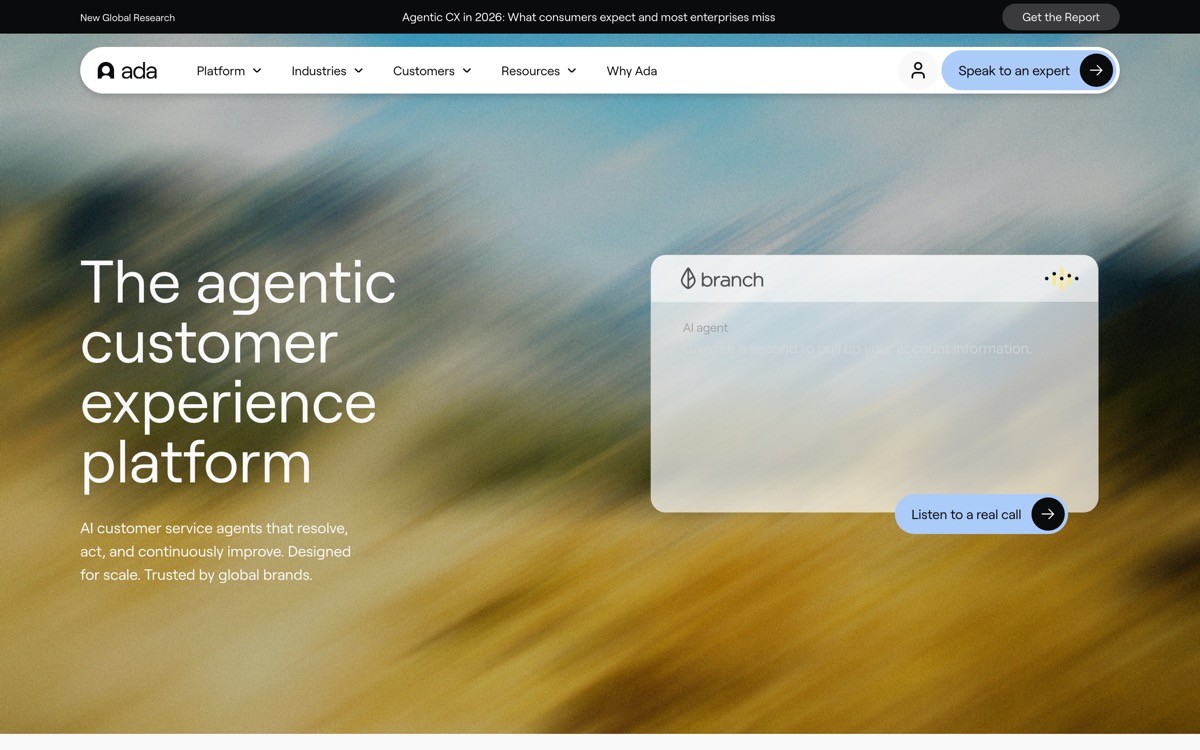
Ada is an AI customer service automation platform built around a no-code agent builder that lets non-technical CX leads design support flows without engineering help. The UX combines a visual flow builder with generative reasoning, so simple flows stay declarative while complex ones lean on the LLM.
The distinctive value is the visual flow surface. Where Decagon and Sierra expect a config language, Ada gives CX leads a drag-and-drop canvas plus an AI layer that fills the gaps. It is the most accessible enterprise-grade support agent UX in 2026.
Key strengths
No-code visual flow builder for support workflows
Generative reasoning layer that handles flow gaps automatically
Multi-language support across 50-plus languages
Integrations with major helpdesks, CRMs, and CMS platforms
Analytics surface with resolution and CSAT tied to flows
Brand voice and tone controls
Best for
CX teams without engineering support that need to ship flows themselves
Global brands needing strong multi-language support out of the box
Pricing
Custom pricing on request
Typically priced per agent plus volume tier
Pros
Most CX-lead-friendly builder UX in the category, no engineering bottleneck
Strong multi-language coverage is unique at this tier
Visual canvas plus generative layer is a clean hybrid
Cons
Flow builder can become unwieldy for very complex enterprise procedures
Pricing opaque, hard to estimate without a sales conversation
5. Forethought, best ticket-triage support agent UX
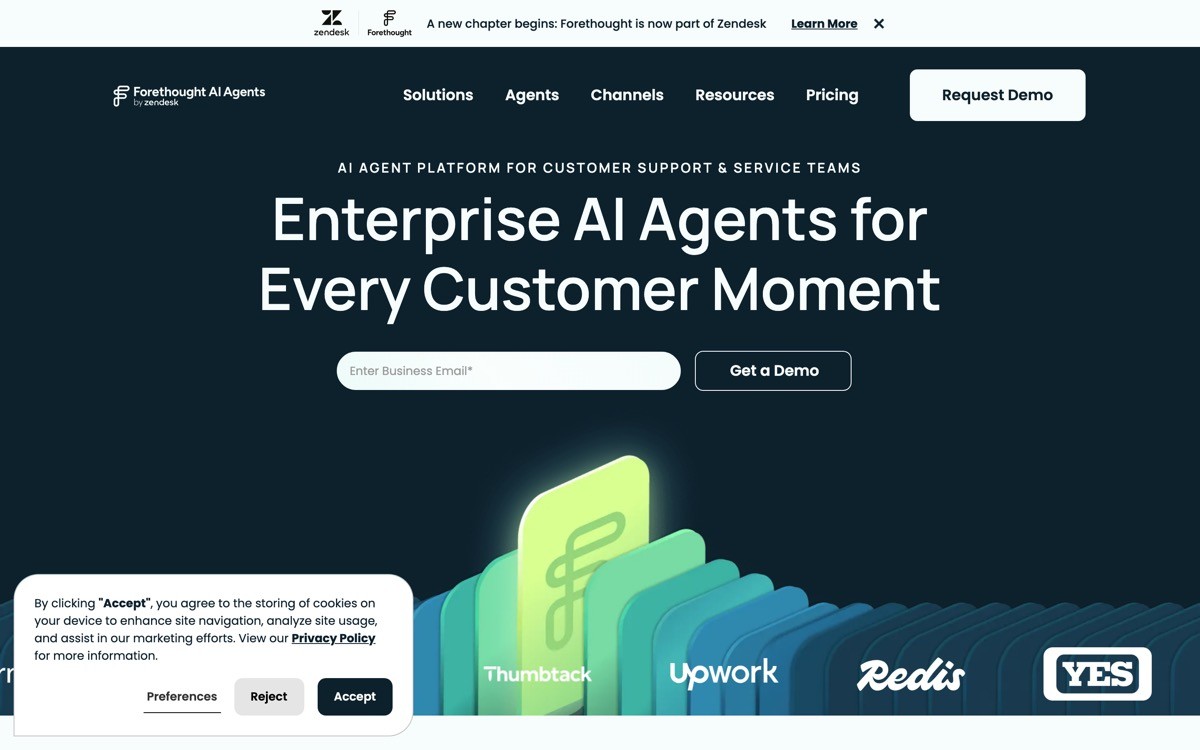
Forethought is an AI support agent that sits inside Zendesk and Salesforce Service Cloud and focuses on the ticket layer: predicting intent, routing to the right queue, and surfacing draft responses for human agents. The UX never leaves the helpdesk the support team already uses.
The distinctive value is the in-helpdesk posture. Forethought does not ask the support team to learn a new interface. It augments the existing ticket view with intent prediction, sentiment scoring, and recommended responses, all rendered inline in Zendesk or Salesforce.
Key strengths
Inline ticket triage and routing in Zendesk and Salesforce
Intent prediction with confidence scoring
Solve autonomous deflection for tier-1 tickets
Assist sidebar with draft responses for human reps
Discover for surfacing knowledge gaps from ticket patterns
Native integration with existing helpdesk workflows
Best for
Support teams already committed to Zendesk or Salesforce who do not want to change platforms
Operations leaders focused on routing accuracy and tier-1 deflection rather than full automation
Pricing
Custom pricing on request
Typically tiered by ticket volume and feature set
Pros
Lowest-friction adoption for existing Zendesk and Salesforce teams
Intent prediction with confidence scoring is the clearest routing signal
Discover turns ticket data into knowledge-base recommendations
Cons
Tied to specific helpdesks, less useful outside Zendesk and Salesforce ecosystems
Less feature parity for end-to-end conversational support compared with Fin or Decagon
6. Cresta, best agent-assist support agent UX
Cresta is an AI support agent that does not replace human reps but coaches them in real time during voice and chat conversations. The UX renders suggestion cards next to the live transcript, with playbook prompts the rep can click or ignore.
The distinctive value is the live-coaching surface. Cresta does not try to be the customer-facing agent. It is the silent layer on top of the human rep, surfacing the best next thing to say based on company playbooks and patterns across thousands of past conversations. The trust mechanism is that the human always speaks the final words.

Key strengths
Real-time coaching cards rendered next to the live conversation
Playbook-driven suggestions with rationale shown to the rep
Post-call AI summaries and QA scoring
Coaching insights surfaced to managers for team-level improvement
Works across voice and digital channels
Enterprise audit and compliance controls
Best for
Sales and support teams that keep humans in the loop and want AI to amplify them
Contact centers focused on quality and coaching rather than full deflection
Pricing
Custom enterprise pricing on request
Typically priced per seat per month
Pros
Human-in-the-loop trust UX, the rep always controls the final word
Live coaching cards address the moment of need, not after-the-fact training
Post-call summaries plus QA scoring create a strong learning loop
Cons
Not a customer-facing agent, so it does not deflect tickets the way Fin or Decagon do
Suggestion cards can overwhelm reps if not carefully tuned
7. Plivo CX, best voice-first support agent UX
Plivo CX is an AI customer experience platform that combines telephony infrastructure with conversational agents in a single stack. The UX makes voice the primary channel: the agent answers the phone, handles the conversation, and hands off to a human only when escalation is warranted.
The distinctive value is the unified voice plus AI stack. Where most support agents bolt voice onto a chat-first product, Plivo CX builds the agent on top of its own telephony, which keeps latency low and call quality high. For support flows that live on the phone (logistics, healthcare, field services), that integration matters.

Key strengths
Telephony and AI agent in one platform with low latency
Voice agent for inbound and outbound calls
Omnichannel surface across voice, SMS, WhatsApp, and chat
Call recording plus AI summary on every conversation
Customer record persists across channels
CPaaS heritage gives strong global voice coverage
Best for
Teams whose customers prefer phone over chat (logistics, healthcare, field services)
Companies that want one vendor for voice infrastructure and conversational AI
Pricing
Usage-based pricing tied to voice minutes and AI conversations
Custom enterprise pricing on request
Pros
Voice and AI in one platform reduces vendor sprawl and latency
Strong global telephony reach inherited from Plivo's CPaaS roots
Omnichannel customer record is competitive with the chat-first agents
Cons
Newer entrant compared with Decagon or Sierra on the conversational AI side
Voice-first positioning means less polished if chat is your main channel
How to choose the best AI customer support agent UX for your team
1) Are you deflecting tickets or coaching humans?
Deflection-first teams pick Intercom Fin, Decagon, Sierra, or Ada because those agents talk to the customer directly. Coaching-first teams pick Cresta because it sits on top of the human rep and surfaces suggestions in real time. Forethought sits in the middle, handling routing and draft responses inside the helpdesk.
Customer-facing deflection: Intercom Fin, Decagon, Sierra, Ada, Plivo CX
Rep-facing coaching: Cresta
Triage and draft assist: Forethought
2) How regulated is your support flow?
Regulated industries (finance, healthcare, telco) need procedure-as-config, step-level audit trails, and permission-aware actions. Decagon and Ada lead on the configuration surface. Sierra and Plivo CX layer in enterprise controls. Avoid agents that hide the prompt behind a black box if compliance owns the rollout.
3) What is your primary channel?
Chat-first teams should evaluate Intercom Fin or Decagon. Brand-voice-first ecommerce should evaluate Sierra. Voice-first teams in logistics or field services should evaluate Plivo CX. Multi-channel teams need a vendor whose customer record persists across channels, which most enterprise agents now offer but few mass-market tools do.
4) Who configures the agent?
If a CX lead with no engineering support owns the agent, Ada's no-code builder is the strongest fit. If a CX engineer or AI lead is on staff, Decagon's procedure-as-config or Sierra's persona configuration unlock more depth. Forethought sits inside the helpdesk and requires minimal new tooling.
If you have picked your customer support agent but the help center, customer portal, and admin UI around it still look templated, that is where support agents lose customer trust in 2026. AY Design turns AI support products into interfaces customers actually trust, with help center redesigns that convert deflection into self-service, admin dashboards that earn CX-lead trust, and brand systems that hold up under the agent's voice. Book a design audit to see what to fix first.
FAQ
What is an AI customer support agent?
An AI customer support agent is a software tool that uses a large language model plus knowledge retrieval and action tools to handle customer service conversations end to end. The best AI customer support agents in 2026 (Intercom Fin, Decagon, Sierra, Ada, Forethought, Cresta, Plivo CX) all surface confidence per turn, expose a clean human handoff, and treat the admin debug view as a primary product surface.
Which AI customer support agent has the best UX?
Intercom Fin and Decagon currently set the bar for AI customer support agent UX in 2026. Fin wins on mass-market deflection metrics surfaced as the primary admin view. Decagon wins on enterprise procedure-as-config with step-level audit trails. Sierra is the strongest for brand-voice-led consumer experiences.
What is the difference between Intercom Fin and Decagon?
Intercom Fin is a deflection-first agent built into the Intercom Messenger and tuned through topics, answers, and knowledge sources. Decagon is an enterprise agent built around AI Agent Operating Procedures, explicit multi-step workflows the agent must follow with step-level audit trails. Choose Fin for fast time-to-value on Intercom; choose Decagon for regulated, high-stakes workflows.
Can AI support agents take actions like refunds and account changes?
Yes, modern AI support agents like Decagon, Sierra, and Ada can take actions through CRM and tooling integrations, not just answer questions. The UX challenge is making those actions auditable and reversible. Look for agents that show the action's parameters before execution and log the result in an admin view.
How do AI support agents handle the handoff to a human?
The best AI support agents preserve the full conversation context, the agent's confidence trail, and any actions taken, then route the customer to a human with a one-click handoff. Intercom Fin and Decagon do this cleanly inside their existing inbox. Forethought handles handoff inside Zendesk and Salesforce. A weak handoff (where the human has to ask the customer to re-explain) is the fastest way to lose trust.
What is agent assist?
Agent assist is an AI support pattern where the agent does not replace the human rep but coaches them in real time with suggested responses, knowledge pull-ups, and playbook prompts. Cresta is the canonical agent-assist product. Forethought Assist sits inside Zendesk and Salesforce for a similar role. Agent assist works well for teams that want to keep humans in the loop while still capturing AI gains.
How much does an AI customer support agent cost?
AI customer support agent pricing in 2026 ranges from around $0.99 per resolved conversation (Intercom Fin) to custom enterprise pricing in the six-figure-annual range (Decagon, Sierra, Cresta). Per-resolution pricing aligns vendor and customer incentives but can spike at high volume; per-seat pricing is more predictable but does not punish low-performing agents.
Should I build my own support agent UX?
Build a custom support agent UX only if you have a vertical the off-the-shelf platforms do not handle well (clinical triage, regulated financial advice, complex industrial troubleshooting). Otherwise, lift the patterns from Intercom Fin, Decagon, and Sierra: confidence per turn, procedure-as-config, persona surface, clean handoff. If you want a design partner to ship a custom support agent UX that earns trust, an AI-product design agency can adapt the proven patterns to your vertical without forcing customers to relearn how support works.
Checkout other Blogs:

Multi-agent system UX design guide for 2026
A pattern-by-pattern guide to designing multi-agent system UX in 2026, with a scoring matrix and references from Claude Code, LangGraph, Devin, and Replit Agent.
Author:
AY Designs Team
Human-in-the-loop AI design guide for 2026
A 2026 guide to human-in-the-loop AI design with patterns, scoring framework, and examples from Cursor, Claude Code, Stripe, and Notion AI.
Author:
AY Designs Team

How to design agentic AI products in 2026: a 7-step playbook
A seven-step design playbook for shipping agentic AI products that users actually trust, with scoring matrix and real product references from Cursor, Claude Code, Devin, and Perplexity.
Author:
AY Designs Team

How much does AI SaaS design cost in 2026?
AI SaaS design cost in 2026 by tier and engagement type, with ranges, timelines, and a value scorecard for founders shipping with Lovable, Bolt, and v0.
Author:
AY Designs Team