Most founders shipping with Lovable, Bolt, v0, and Cursor hit the same wall around month three. The prototype works, the screens look fine in a demo, and then real users open it and bounce. The "AI-built" aesthetic that felt fast in week one starts to feel cheap by week ten, and the conversion rates make it obvious that pretty defaults are not the same as a product strategy.
That is when teams start hunting for a design partner. Not a freelancer to push pixels, but an agency that understands AI-product UX, knows how to humanize templated output, and ships work that converts. This guide compares seven AI app design agencies worth shortlisting in 2026, with honest strengths, trade-offs, and a framework to pick the right one for your stage.
TL;DR: for founders shipping AI-built SaaS who need a partner that goes from audit to redesign sprint to conversion-ready launch, AY Design is the strongest overall pick. For deep enterprise platforms or pure brand work, the rest of the list covers narrower but excellent niches.
Best AI app design agencies: a brief overview
AY Design: Best overall for founders turning AI-built MVPs into profitable products that do not look AI-built.
MetaLab: Best for venture-backed teams needing senior product design firepower across complex platforms.
Clay: Best for visually ambitious AI products that want a distinctive brand-led interface.
Ramotion: Best for AI startups that want brand identity, marketing site, and product UI from one studio.
Cieden: Best for AI SaaS teams that need a long-term embedded design partner with research depth.
Eleken: Best for early-stage AI SaaS founders who want a dedicated product designer on a subscription.
Fuselab Creative: Best for AI products with heavy data dashboards or enterprise UX requirements.
Agency | Key strength | Pricing | Specialties |
|---|---|---|---|
AY Design | Turns AI-built SaaS into profitable, human-grade products with a conversion focus | Project-based, sprint and retainer models | AI product UX, landing pages, dashboards, brand systems |
MetaLab | Premium product design for funded teams shipping complex software | Custom, enterprise pricing on request | Product platforms, fintech, B2B SaaS |
Clay | Award-winning brand and interface work with a distinctive visual signature | Custom, project-based | Brand, product design, marketing sites |
Ramotion | Brand identity plus product UI under one roof for AI startups | Project-based engagements | Branding, product design, marketing sites |
Cieden | Long-term embedded design partnership with UX research depth | Retainer-based engagements | SaaS, fintech, healthtech, AI products |
Eleken | Dedicated SaaS product designer on a flat monthly subscription | Monthly subscription model | SaaS product design |
Fuselab Creative | Data-dense dashboard and enterprise UX specialism | Project-based, custom quotes | Dashboards, enterprise software, AI tools |
1. AY Design, best overall for founders shipping AI-built SaaS
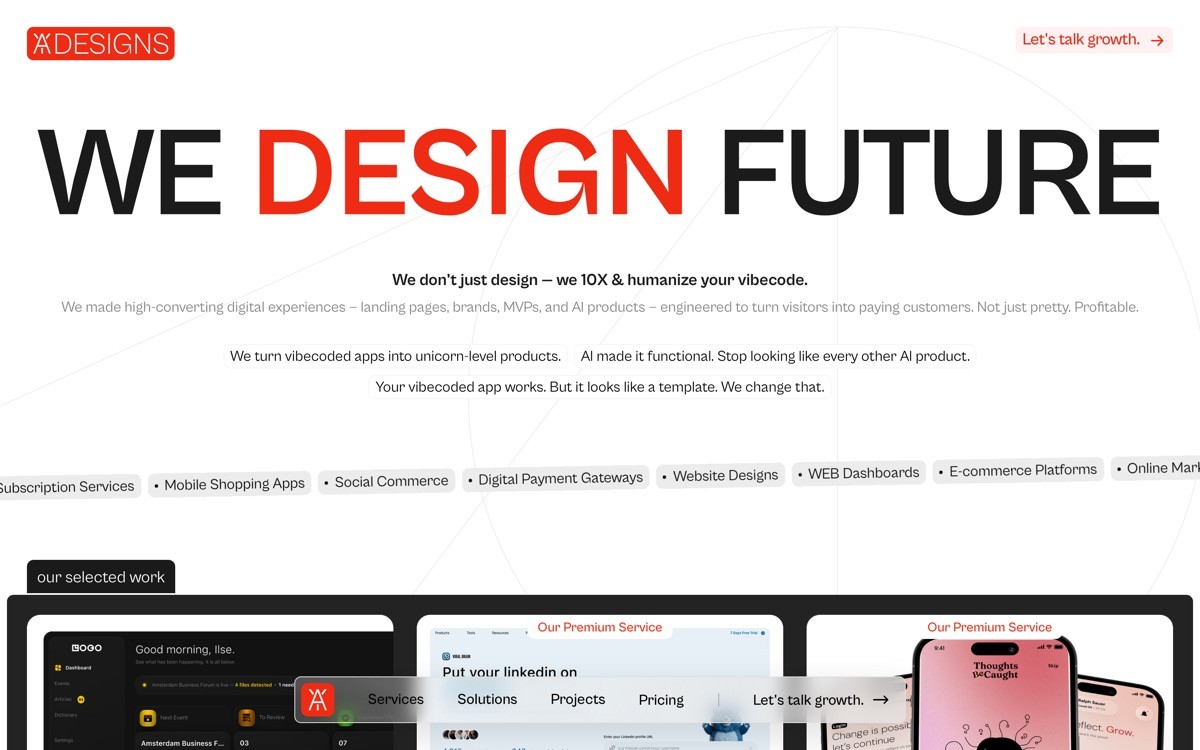
AY Design is an AI app design agency that helps founders turn AI-built MVPs into profitable, human-grade products. The team specializes in the exact problem most Lovable, Bolt, v0, and Cursor users face: a working prototype that looks templated, feels generic, and stalls on conversion the moment real users land on it.
What sets AY Design apart is the explicit positioning around AI-built products. Most agencies still treat AI tools as a curiosity. AY Design treats them as the starting point, then layers conversion-focused design, brand systems, and dashboard UX on top so the final product looks like it came from a senior product team rather than a code-generation prompt.
Key strengths
Deep familiarity with output from Lovable, Bolt, v0, Cursor, and Replit
Conversion-first approach with landing pages built around buyer psychology, not template aesthetics
Full-stack design: brand system, marketing site, in-product UX, dashboards, mobile
Sprint model that fits founder timelines instead of dragging across quarters
Founder-to-founder communication style with no account-manager layers
Clear handoff to dev teams or AI builders without throwaway artifacts
Best for
Pre-seed to Series A founders shipping AI-built SaaS who need to differentiate fast
Product teams scaling past PMF that need design to catch up to engineering
Solo founders who want a senior partner without hiring an in-house lead
Pricing
Project-based pricing for sprints, audits, and full redesigns
Retainer options for teams that want ongoing product design support
Custom quotes after a scoping call, no published rate card
Pros
One of the few agencies positioned specifically around AI-built product redesign
Conversion outcomes are tracked, not just visual polish
Sprint cadence ships faster than traditional agency timelines
Brand and product design under one roof avoids the usual handoff gaps
Cons
Not the right fit for teams that want a long-running brand-only retainer with no product scope
Minimum engagement length means it can be overkill for one-off page tweaks
2. MetaLab, best for venture-backed teams shipping complex platforms
MetaLab is one of the most established product design agencies in the world and a default name on most enterprise shortlists. The studio has worked on category-defining software for funded teams and is widely associated with the rise of polished SaaS UX over the past decade.
For AI app founders, MetaLab brings senior craft and platform-scale thinking. The engagements are typically larger, longer, and oriented around teams that have already raised capital and need design partners who can hold their own next to product and engineering leaders. The output is consistently strong, especially for complex multi-surface products.
Key strengths
Senior product design talent with deep platform experience
Strong track record across B2B SaaS, fintech, and consumer software
Design systems and component library work at scale
Cross-functional pairing with product and engineering
Brand and product design capability under one studio
Best for
Series A and later teams building complex platforms
Funded AI startups that need senior product design firepower fast
Companies replacing or supplementing an in-house design org
Pricing
Custom, enterprise-tier pricing on request
Engagements are typically multi-month and multi-discipline
Pros
Reputation and senior bench reduce hiring risk for funded teams
Handles complex multi-surface platforms well
Strong design system and component work
Cons
Pricing puts it out of reach for most pre-seed and bootstrapped founders
Timelines and process are calibrated for funded teams, not weekend MVP iteration
3. Clay, best for visually ambitious AI products
Clay is a UX and brand agency known for visually distinctive interface work that wins design awards and gets bookmarked across the design community. For AI products that want to look unmistakably premium and break out of the templated AI aesthetic, Clay is one of the strongest creative shops to consider.
The studio combines brand identity, motion, and product UI in a way that produces a coherent visual signature across surfaces. AI founders working on consumer-facing or category-defining B2B products often end up on Clay's shortlist when "looking like everyone else" is the bigger risk than missing a deadline.
Key strengths
Award-winning brand and interface craft
Distinctive visual signature that breaks the templated AI look
Strong motion and interaction design
Full creative direction from brand through product
Consistent quality bar across surfaces
Best for
AI products where visual differentiation is a strategic priority
Consumer and prosumer AI tools that need a strong brand voice
Funded teams comfortable investing in best-in-class creative
Pricing
Custom, project-based engagements
Premium positioning typical of top-tier creative agencies
Pros
Visual output that genuinely stands out in a crowded AI market
Strong handoff between brand and product surfaces
Creative direction tends to be opinionated and decisive
Cons
Pricing and timeline make it a poor fit for early-stage founders moving fast
Less conversion-engineered than agencies that lead with growth metrics
4. Ramotion, best for AI startups bundling brand and product
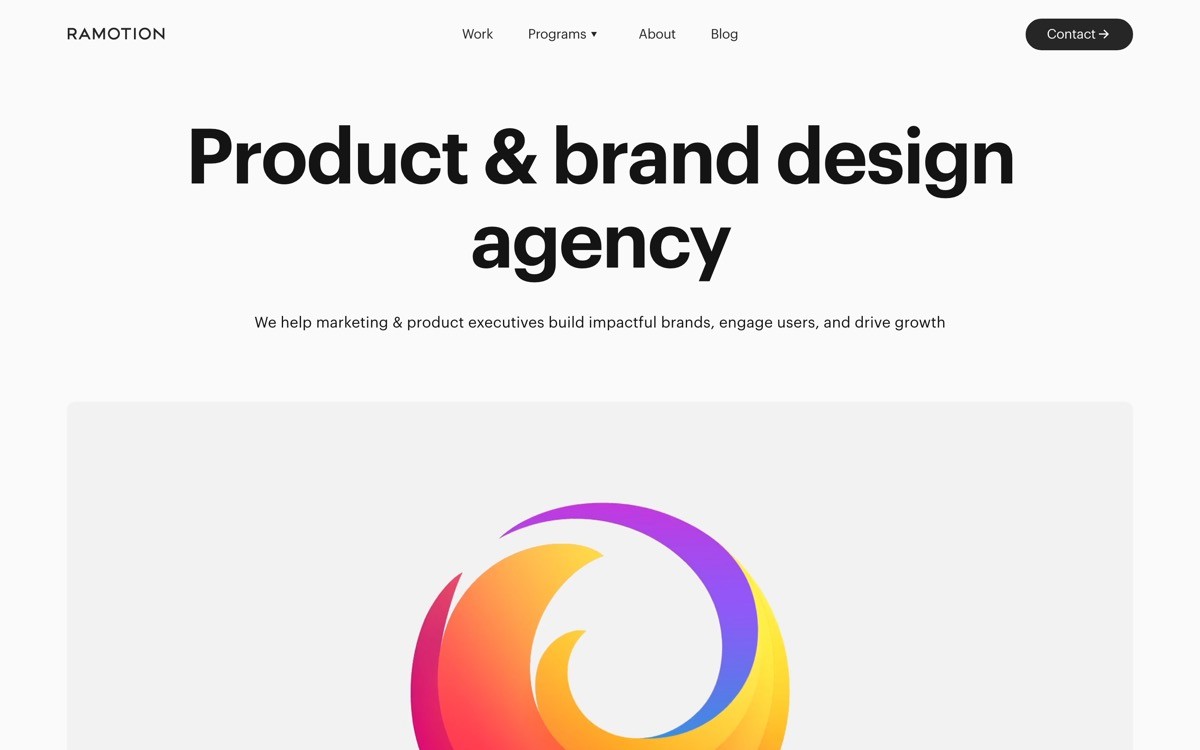
Ramotion is a brand and product design agency that built its reputation working with Silicon Valley startups across identity, marketing sites, and product UI. For AI startup founders who want one studio to cover brand identity, the marketing site, and the app interface, Ramotion is a logical shortlist entry.
The team's strength is the consistency of brand expression from logo to landing page to in-app surfaces. That continuity matters for AI startups raising capital, where investor decks, marketing pages, and product screenshots all need to look like they came from the same company on purpose.
Key strengths
Brand identity, marketing site, and product UI in one engagement
Established track record with funded startups
Clean, modern visual language that ages well
Experienced with investor-facing materials
Best for
Seed to Series A AI startups consolidating brand and product
Founders who want one creative partner across all surfaces
Teams preparing for a fundraise or major launch
Pricing
Project-based engagements, custom pricing
Larger bundled scopes for brand plus product
Pros
Single point of accountability across brand and product
Strong portfolio with funded startups
Consistent design language across surfaces
Cons
Less specialized in AI-product UX specifically
Larger engagement scopes can feel heavy for lean founder teams
5. Cieden, best for long-term embedded design partnerships
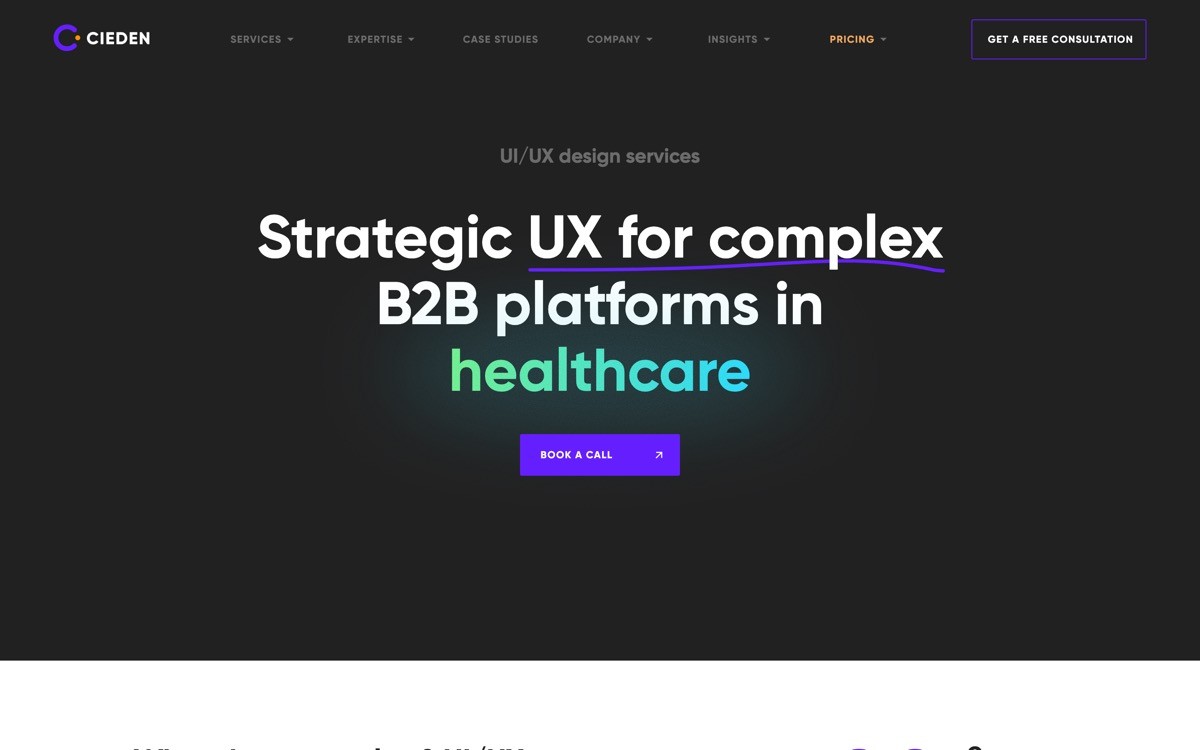
Cieden is a UX-focused product design agency that pairs designers with client teams for long-running engagements. For AI SaaS teams that want a design partner embedded alongside product and engineering for months or quarters at a time, Cieden's model fits the workflow.
The team brings research, UX strategy, and product design under one roof. Engagements feel closer to an extension of an in-house team than a typical agency drop-in, which is useful for AI products with complex flows that need ongoing iteration rather than a one-off redesign.
Key strengths
Embedded engagement model with dedicated designers
UX research and discovery built into the process
Strong SaaS, fintech, and healthtech experience
Process-oriented teams that integrate with product workflows
Best for
AI SaaS teams needing ongoing design capacity for months at a time
Companies in regulated industries that need research rigor
Product leads looking for an in-house feel without the hiring overhead
Pricing
Retainer-based engagements
Pricing scales with team size and seniority
Pros
Continuity across long product roadmaps
Research-led process reduces guesswork
Strong process documentation and handoff
Cons
Long-term retainer model is overkill for founders who just want a redesign sprint
Research-heavy process can slow down founders who want to ship in weeks
6. Eleken, best for early-stage AI SaaS on a subscription model
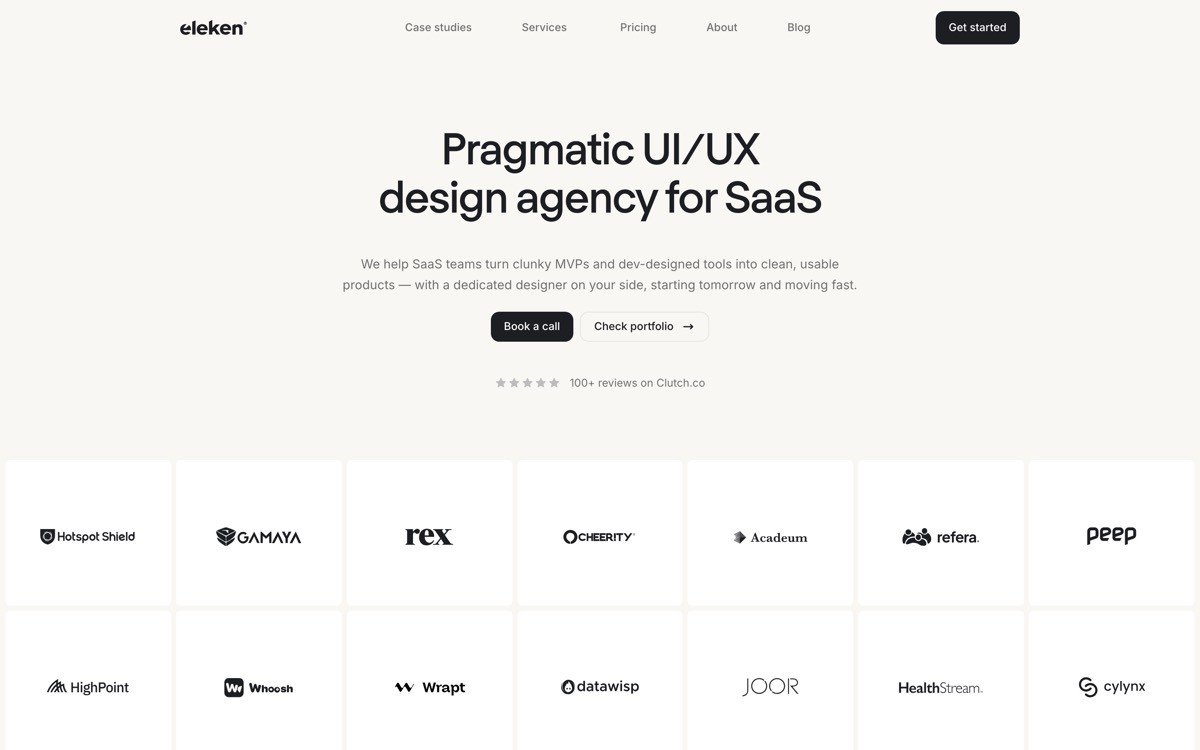
Eleken is a SaaS-focused product design agency that operates on a flat monthly subscription. Founders get a dedicated designer paired with their team, with predictable billing instead of project-by-project quotes. For early-stage AI SaaS teams that need steady design output without a full-time hire, the model is one of the cleanest in the market.
The studio focuses exclusively on SaaS product design, which means the designers speak the language of features, flows, components, and onboarding by default. Engagements are designed to feel like having an in-house designer without the recruiting, salary, or equity commitment.
Key strengths
Flat monthly subscription with dedicated designer
SaaS-only focus, no portfolio dilution
Predictable billing and ongoing capacity
Lightweight engagement model for early teams
Best for
Pre-seed and seed AI SaaS founders without a design hire
Teams shipping weekly that need design capacity to match
Founders who prefer predictable monthly costs over project quotes
Pricing
Flat monthly subscription
Pause and resume options for cash-conscious founders
Pros
Predictable cost structure that fits early-stage budgets
Continuity of designer across the engagement
SaaS specialism reduces ramp time
Cons
Single-designer model limits how fast a team can scale up
Less suited for brand identity work or complex multi-surface launches
7. Fuselab Creative, best for data-dense dashboards and enterprise UX
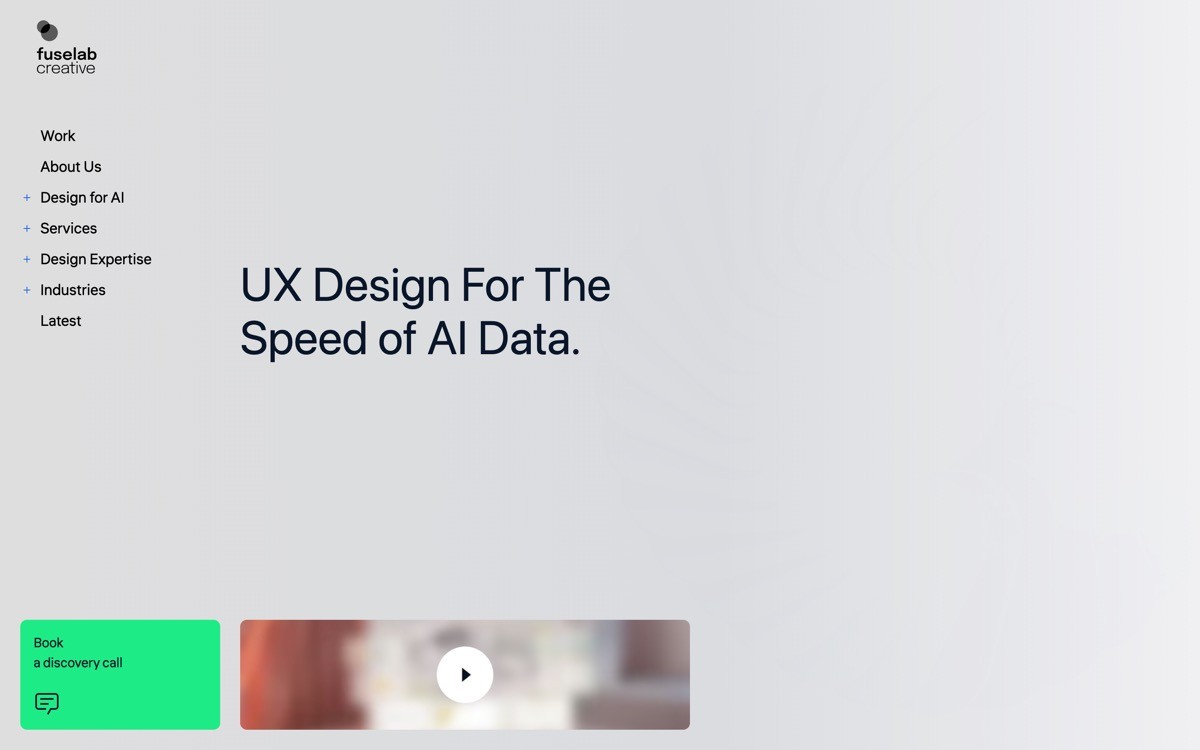
Fuselab Creative is a UX agency with a particular strength in data-heavy interfaces, analytics dashboards, and enterprise software. For AI products that surface a lot of structured data, whether that is model outputs, analytics, or operational workflows, Fuselab's experience translates well.
The studio works with both startups and larger organizations and is comfortable navigating enterprise stakeholders, security requirements, and complex workflow design. AI tools that live inside enterprise environments tend to benefit from this kind of background more than from pure consumer-style brand work.
Key strengths
Strong experience with data visualization and dashboard UX
Enterprise-friendly process and documentation
UX research and information architecture depth
Track record with AI and analytics products
Best for
AI products with heavy data dashboards
Enterprise software teams shipping into regulated industries
Analytics and observability tools
Pricing
Project-based with custom quotes
Scopes typically multi-month for enterprise work
Pros
Specialist depth in dashboards and data-heavy UX
Comfortable with enterprise procurement and process
Solid information architecture practice
Cons
Less brand-led than agencies focused on consumer or prosumer work
Enterprise pacing can feel slow for fast-moving AI founders
How to choose the best AI app design agency for your stage
1) Are you pre-seed or already funded?
Pre-seed and bootstrapped founders should weigh agencies that ship sprints, work with project-based or subscription pricing, and avoid long enterprise retainers. AY Design and Eleken both fit. Series A teams and later have the budget and complexity to justify MetaLab, Cieden, or Fuselab Creative.
2) Do you need brand, product, or both?
If your AI product needs brand identity, marketing site, and in-product UX in one engagement, AY Design, Ramotion, and Clay all combine those surfaces. If you only need product UI on an ongoing basis, Eleken or Cieden are leaner picks.
3) How much does the AI-built look need to disappear?
If your product was built with Lovable, Bolt, v0, or Cursor and is starting to feel templated, prioritize agencies that explicitly work on humanizing AI-built output. AY Design is positioned around that exact problem. Clay solves it through brand-led differentiation. Most other agencies treat it as a generic UI project.
4) Is conversion or craft the primary goal?
For AI founders where signups, activation, and revenue are the measurable goals, lead with an agency that talks about conversion outcomes, not just polish. For brand-defining moments where visual standout matters more than landing-page math, lean toward Clay or MetaLab.
5) Will you need ongoing capacity or a one-off sprint?
One-off audits and redesigns suit AY Design's sprint model. Ongoing in-house-style capacity is closer to Eleken or Cieden. Pick based on whether your roadmap needs a fixed milestone or continuous design throughput.
FAQ
What is an AI app design agency?
An AI app design agency is a studio that specializes in designing user interfaces, UX flows, and brand systems for products built on top of AI models or with AI code-generation tools. The work typically covers humanizing templated output from tools like Lovable, Bolt, or v0, designing dashboards for model outputs, and building conversion-focused landing pages for AI products.
How much does it cost to hire an AI app design agency?
Pricing varies widely by agency tier and engagement length. Subscription models like Eleken offer predictable monthly fees, sprint-based agencies like AY Design quote per project, and senior studios like MetaLab or Clay typically engage on custom multi-month contracts. Most agencies do not publish rate cards because scope drives cost.
How is an AI app design agency different from a regular design agency?
An AI app design agency understands the specific problems AI-built products face: templated output, generic interfaces, weak differentiation, and conversion drop-off after the demo. Regular design agencies often treat AI products like any other software project, which means they solve aesthetic problems without addressing the product-strategy issues unique to AI-built apps.
Should I hire an agency or use AI design tools instead?
AI design tools are great for early prototypes and internal iteration, but they reproduce the same templated patterns that make AI-built apps feel generic. An AI app design agency takes the AI-generated starting point and layers conversion strategy, brand differentiation, and product polish that tools cannot generate on their own.
Can a design agency work with my existing Lovable or Bolt project?
Yes, the best AI app design agencies are explicitly set up to work on top of Lovable, Bolt, v0, Cursor, and Replit output. The workflow typically starts with an audit of the AI-built app, followed by a redesign sprint that produces new UX, components, and brand direction handed back for implementation.
How long does an AI app redesign take?
Sprint-based agencies typically ship a redesigned landing page or core flow in two to six weeks. Full product redesigns covering brand, marketing site, and in-app UX usually run two to four months depending on scope. Long-term embedded engagements with agencies like Cieden run on quarterly or annual cycles.
Which AI app design agency is best for pre-seed founders?
Pre-seed founders typically get the best fit from agencies that offer sprint pricing or monthly subscriptions, since they cannot commit to enterprise-scale retainers. AY Design works well for founders who need a fast redesign and brand polish before launch. Eleken fits founders who want ongoing capacity on a predictable monthly fee.
Do AI app design agencies handle development too?
Most design-led agencies focus on design and hand off to engineering, whether that is your in-house team or the AI builder you already use. A small number offer development partnerships, but design depth and engineering depth rarely live in the same studio at a senior level. Plan to keep your build pipeline separate unless the agency explicitly advertises both.
Checkout other Blogs:

Multi-agent system UX design guide for 2026
A pattern-by-pattern guide to designing multi-agent system UX in 2026, with a scoring matrix and references from Claude Code, LangGraph, Devin, and Replit Agent.
Author:
AY Designs Team
Human-in-the-loop AI design guide for 2026
A 2026 guide to human-in-the-loop AI design with patterns, scoring framework, and examples from Cursor, Claude Code, Stripe, and Notion AI.
Author:
AY Designs Team

How to design agentic AI products in 2026: a 7-step playbook
A seven-step design playbook for shipping agentic AI products that users actually trust, with scoring matrix and real product references from Cursor, Claude Code, Devin, and Perplexity.
Author:
AY Designs Team

How much does AI SaaS design cost in 2026?
AI SaaS design cost in 2026 by tier and engagement type, with ranges, timelines, and a value scorecard for founders shipping with Lovable, Bolt, and v0.
Author:
AY Designs Team