
Sales is the AI agent category where UX directly drives revenue. The agent finds the prospect, enriches the data, drafts the email, schedules the send, and (sometimes) handles the reply. If the interface hides what the agent did, the rep cannot trust the pipeline. If the data is wrong, the email gets ignored. If the personalization sounds like ChatGPT, the deal dies before it starts.
The sales agents winning in 2026 share a tight set of UX patterns: enrichment shown as a cell-level trace, draft emails rendered with the personalization source highlighted, sequence builders that treat steps as auditable units, and a confidence score on every action so the rep knows when to override. This guide pulls apart six AI sales agents and the specific UX moves you can borrow when designing your own go-to-market product.
TL;DR, if you only steal one pattern, copy Clay and Lavender: render every enrichment and personalization with the source visible at the cell level, and let the rep edit any step without losing the agent's context.
Best AI sales agent UX: a brief overview
Clay: Best data enrichment sales agent UX, spreadsheet-as-agent surface with cell-level enrichment.
Outreach AI: Best sequencing sales agent UX, AI suggestions embedded inside the rep's existing sequence flow.
Salesforce Agentforce: Best CRM-native sales agent UX, agents live inside Salesforce records.
Apollo AI: Best all-in-one sales agent UX, prospecting plus engagement plus dialer.
Lavender: Best email-writing sales agent UX, real-time scoring of every draft.
Regie.ai: Best autonomous prospecting sales agent UX, AI SDR that builds and runs sequences end to end.
Product | Tool-call UX | Memory or context UX | Trust or citation UX | Speed | Score |
|---|---|---|---|---|---|
Clay | Spreadsheet cells as agent tool calls | Persistent tables and waterfall enrichment | Source trace per cell, confidence per provider | Async per row, fast at scale | 9.4 / 10 |
Outreach AI | AI inline in the sequence builder | Account and prospect history | Suggestion source and rationale | Real-time inside the workflow | 8.8 / 10 |
Salesforce Agentforce | Agents run on records via Atlas reasoning | Salesforce CRM data as native memory | Action log on the record | Real-time inside Salesforce | 8.6 / 10 |
Apollo AI | Sequencing plus prospecting plus dialer in one | Apollo database plus your CRM sync | Suggested personalization with source | Fast across the workflow | 8.4 / 10 |
Lavender | Email scoring inline in Gmail and Outlook | Account and prospect context pulled into draft | Score breakdown with rationale | Real-time while writing | 9.0 / 10 |
Regie.ai | Autonomous AI SDR with admin oversight | Prospect persona and content library | Email draft preview with source | Async campaign runs | 8.5 / 10 |
1. Clay, best data enrichment sales agent UX
Clay is a sales data agent that treats a spreadsheet as the primary surface, where every cell can be powered by a tool call (enrichment, scraping, LLM prompt, or API request). The UX makes the agent's work legible by showing the source of every enriched value at the cell level.
The distinctive value is the spreadsheet-as-agent pattern. Sales ops teams already think in tables, and Clay makes that table the place the agent works. Waterfall enrichment chains multiple providers, and the rep can see which provider returned which value and at what confidence.

Key strengths
Spreadsheet-as-agent surface, cells are the tool call
Waterfall enrichment across multiple providers with source trace
Built-in LLM column for generating personalized copy per row
Direct integrations with Salesforce, HubSpot, Outreach, Apollo
API and webhook outputs for downstream automation
Templates for common prospecting workflows
Best for
Sales ops and growth teams running data enrichment and outbound at scale
RevOps leaders who want a single surface for enrichment, scoring, and routing
Pricing
Free tier with limited credits
Starter at $149 per month, Pro at $349 per month
Enterprise pricing for high-volume teams
Pros
Cell-level source trace is the cleanest enrichment provenance UX in the category
Waterfall enrichment beats single-provider tools on data quality
LLM column closes the loop from data to personalized copy
Cons
Credits-based pricing makes large runs unpredictable without careful planning
Power users only, casual reps will not get value without ops setup
2. Outreach AI, best sequencing sales agent UX
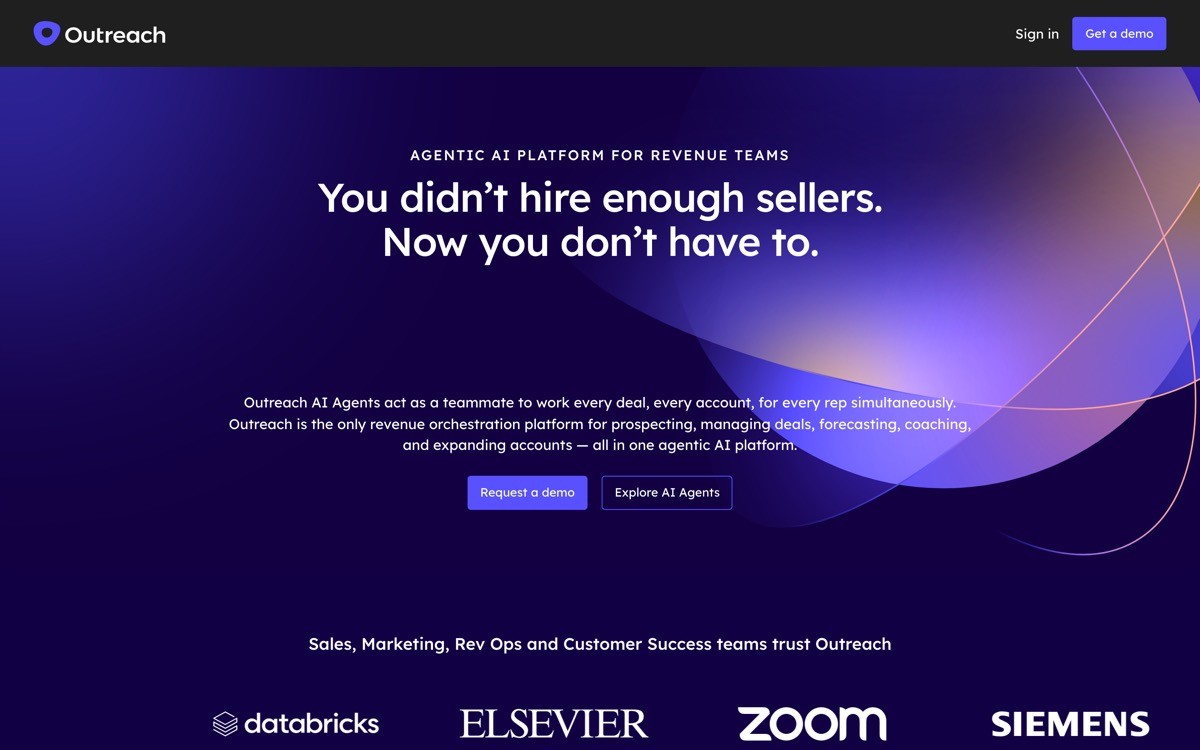
Outreach AI is the AI layer inside Outreach, the enterprise sales engagement platform, that embeds AI suggestions directly into the sequence builder reps already use. The UX strategy is augmentation: do not ask the rep to leave the sequence view to get AI help.
The distinctive value is the in-workflow positioning. Where standalone AI tools force reps to switch tabs, Outreach AI lives inside the same screen where reps build cadences, write emails, and review activity. AI-suggested next steps, draft replies, and account summaries appear as inline cards.
Key strengths
AI suggestions embedded inside the existing sequence builder
Smart Account Plans summarized from CRM and engagement history
Smart Email Assist with reply drafting and personalization
Forecasting and deal-health surfaced on the rep dashboard
Voice transcription and call summary tied to opportunities
Native integration with Salesforce and Microsoft Dynamics
Best for
Enterprise sales orgs already on Outreach who want AI inside the existing workflow
Sales leaders looking to surface AI insights without retraining reps on a new UI
Pricing
Custom enterprise pricing on request
Typically priced per seat per month, AI bundled with the higher tier
Pros
Lowest-friction AI adoption for teams already on Outreach
Smart Account Plans turn data into a rep-readable narrative
Forecasting plus deal health gives leaders an AI-grounded pipeline view
Cons
Tied to Outreach as the base platform, harder to adopt without it
AI features still feel like an add-on layer rather than a redesigned surface
3. Salesforce Agentforce, best CRM-native sales agent UX
Salesforce Agentforce is Salesforce's AI agent framework that runs autonomous agents directly on CRM records, using the Atlas Reasoning Engine to plan and act inside the platform. The UX treats the Salesforce record as the agent's workspace, with every action logged on the record's activity feed.
The distinctive value is the CRM-native posture. Agentforce does not add a new surface, it adds intelligence to the surface every sales team already lives in. The action log on the record becomes the audit trail, and the agent's reasoning surfaces alongside the rep's manual notes.
Key strengths
Agents run directly on Salesforce records with Atlas reasoning
Action log on the record acts as the audit surface
Agent Builder for non-developer configuration
Native data access across Sales Cloud, Service Cloud, Marketing Cloud
Data Cloud as the unified context layer
Enterprise admin, permissions, and audit controls
Best for
Enterprise sales organizations standardized on Salesforce who want AI inside CRM
Teams that need agents to take actions across Sales, Service, and Marketing Cloud
Pricing
Consumption-based pricing per agent action
Bundled with Salesforce Cloud licenses, custom enterprise pricing
Pros
Strongest CRM-native UX in the category, no new tool to adopt
Action log on the record is a natural audit trail for sales leaders
Cross-cloud data access goes deeper than standalone AI tools
Cons
Requires Salesforce as the base platform with significant data hygiene
Consumption pricing is hard to forecast at scale
4. Apollo AI, best all-in-one sales agent UX
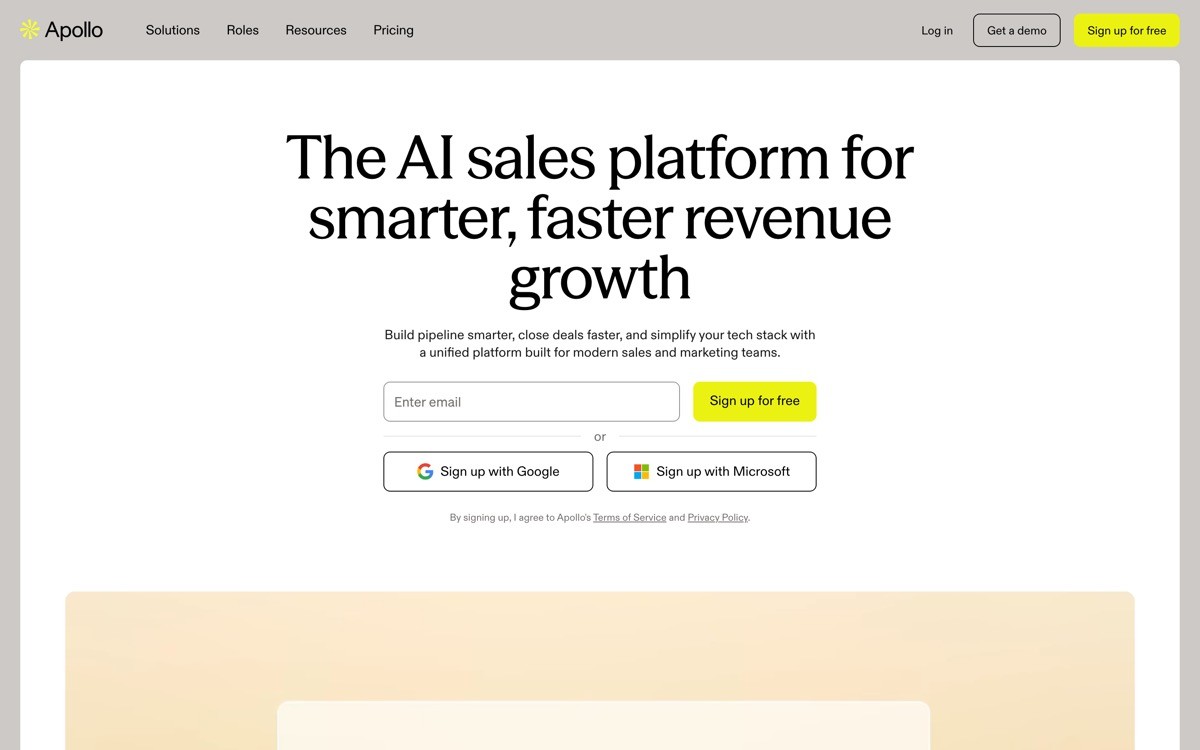
Apollo AI is the AI layer inside the Apollo prospecting and engagement platform, combining a B2B contact database, sequencing, dialer, and AI personalization in one product. The UX strategy is bundling: one tool for the entire outbound motion.
The distinctive value is the breadth. Apollo gives reps prospecting (search the database, build lists), engagement (sequences and dialer), and AI personalization in a single subscription. For SMB and mid-market sales teams that cannot afford a separate Clay, Outreach, and Lavender stack, Apollo collapses the price.
Key strengths
B2B contact database with 275-million-plus contacts
Sequencing, email, dialer, and meeting scheduler in one stack
AI personalization for emails using prospect signals
Chrome extension for in-LinkedIn prospecting
Account-based plays and intent signal integration
CRM enrichment and sync with Salesforce and HubSpot
Best for
SMB and mid-market sales teams that need prospecting and engagement in one tool
Solo founders and small teams running outbound without a dedicated sales ops lead
Pricing
Free tier with limited credits and exports
Basic at $49 per user per month, Professional at $79 per user per month
Organization plans for larger teams
Pros
Best all-in-one breadth for the price in the category
Strong B2B contact database means prospecting starts inside the tool
Chrome extension brings the agent into LinkedIn where reps already work
Cons
Each module is less polished than a best-in-class standalone competitor
Data quality, while broad, lags Clay's waterfall enrichment for hard-to-find contacts
5. Lavender, best email-writing sales agent UX
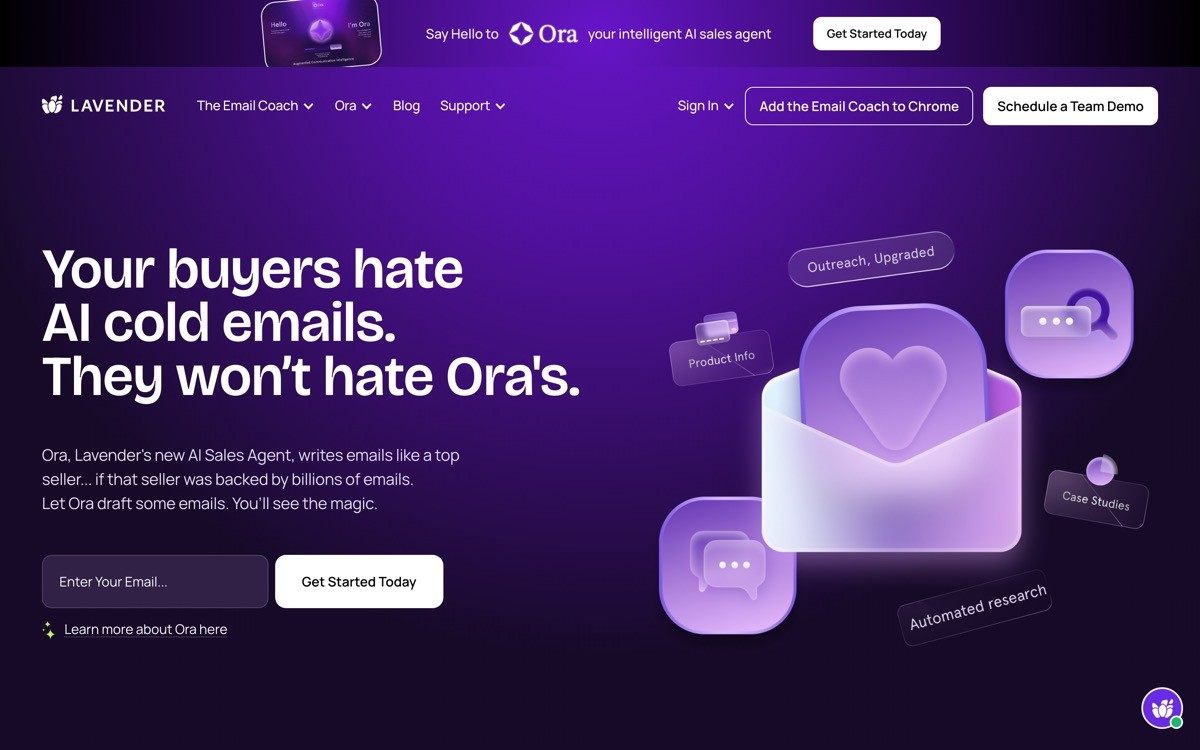
Lavender is an AI sales email coach that scores every draft in real time inside Gmail and Outlook, with a sidebar that surfaces personalization opportunities, tone analysis, and rewrite suggestions. The UX is built around the inline score and the rep's ability to act on it without leaving the email window.
The distinctive value is the live scoring loop. As the rep types, Lavender updates a numerical score, breaks down what is driving it (length, readability, personalization, sentiment), and surfaces prospect signals (recent news, role context, mutual connections) to weave in. It turns email writing into a feedback-driven activity.
Key strengths
Real-time email score with breakdown by factor
Personalization assistant surfacing prospect signals inline
Tone and clarity analysis on every draft
Native integration with Gmail, Outlook, Outreach, and Salesloft
Team coaching dashboard for sales managers
Mobile email coaching for reps on the go
Best for
Reps and sales managers focused on email reply and meeting-booking rates
Teams running outbound where email quality is the constraint
Pricing
Free Starter tier with limited daily scoring
Pro at $29 per user per month, Teams at $49 per user per month
Enterprise pricing for large rollouts
Pros
Strongest in-email coaching UX in the category, score plus rationale plus rewrite
Coaches reps to write better rather than replacing them, which preserves voice
Team dashboard turns individual scoring into manager-level insight
Cons
Narrow scope, email-only, does not handle sequencing or dialer
Score can become a vanity metric if managers do not tie it to reply rate
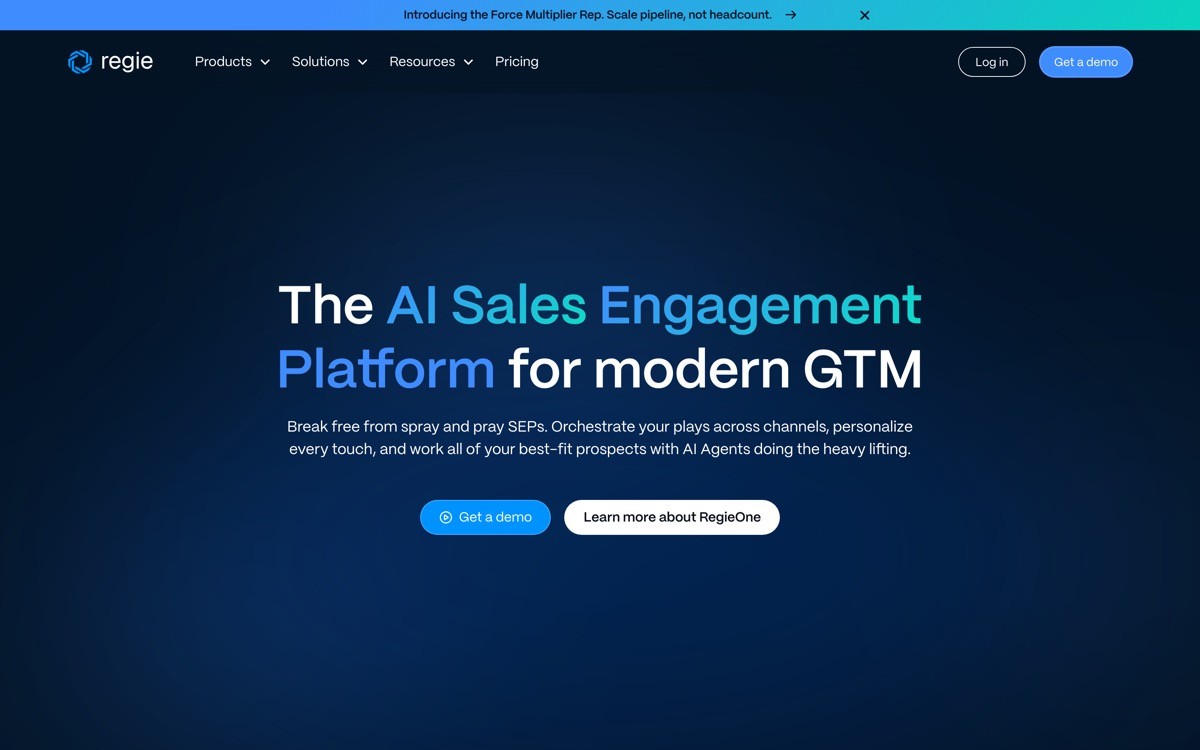
6. Regie.ai, best autonomous prospecting sales agent UX
Regie.ai is an autonomous AI SDR that builds prospect lists, generates personalized sequences, and runs outbound campaigns end to end with admin oversight. The UX treats the agent as a virtual SDR rather than a tool, with a dashboard showing what the agent prospected, drafted, and sent.
The distinctive value is the autonomous-SDR posture. Where Outreach AI and Apollo are tools reps drive, Regie.ai is a worker reps supervise. The admin surface shows the agent's prospects, drafts, and send queue, and the rep can approve, edit, or reject at each step before anything goes out.
Key strengths
Autonomous AI SDR that prospects, drafts, and sends with oversight
Persona configuration for ICP targeting
Content library that grounds drafts in brand voice and case studies
Approval workflow before sequences launch
Multi-channel sequences across email, LinkedIn, and call cadence
Reporting on reply rates and pipeline contribution
Best for
RevOps and sales leaders piloting AI SDR programs without hiring more humans
Mid-market and enterprise teams running high-volume outbound across many ICPs
Pricing
Custom enterprise pricing on request
Typically priced per AI SDR seat per month
Pros
Strongest autonomous-SDR UX in the category, prospect plus draft plus send loop
Approval workflow gives leaders confidence without blocking velocity
Content library keeps drafts grounded in brand voice rather than ChatGPT defaults
Cons
Quality of autonomous sends still depends heavily on persona and content library setup
Less control for hands-on reps who want to drive every step themselves
How to choose the best AI sales agent UX for your team
1) Are you augmenting reps or replacing SDR work?
Augmentation-first teams pick Outreach AI, Apollo AI, or Lavender because those tools sit inside the existing rep workflow. Replacement-first teams pick Regie.ai because that agent runs the SDR loop autonomously with oversight. Clay is a hybrid: an ops surface that powers both augmented reps and autonomous campaigns.
Augment existing reps: Outreach AI, Apollo AI, Lavender, Salesforce Agentforce
Replace or extend SDR work: Regie.ai
Ops surface that powers both: Clay
2) What is your CRM and engagement stack?
If you live in Salesforce, Agentforce is the lowest-friction option because it lives on the record. If you live in Outreach or Salesloft, the native AI inside those tools is the path of least resistance. If you are CRM-agnostic, Clay plus Lavender plus a separate dialer is the modern stack.
3) What is the bottleneck: data, copy, or reps?
Data-bottlenecked teams pick Clay. Copy-bottlenecked teams pick Lavender. Rep-bottlenecked teams pick Regie.ai or Outreach AI to push more activity through fewer humans. Apollo is the bundled answer when the team cannot afford to specialize.
4) How much oversight does the program require?
High-oversight programs (regulated industries, ABM into named accounts) need Salesforce Agentforce, Regie.ai's approval workflow, or Clay's row-level audit. Low-oversight programs (high-volume SMB outbound) work fine on Apollo or Outreach AI with batch review.
If you have picked your sales agent but the sequence builder, admin dashboard, and rep mobile app still look templated, that is where sales agents lose rep trust in 2026. AY Design turns AI sales products into interfaces reps actually want to open every morning, with conversion-focused landing pages, dashboards that make pipeline legible, and brand systems that hold up against generic SaaS sales tools. Book a design audit to see what to fix first.
FAQ
What is an AI sales agent?
An AI sales agent is a software tool that uses a large language model plus enrichment, sequencing, and CRM tools to handle parts of the sales workflow, from prospecting and email drafting to meeting booking and forecasting. The best AI sales agents in 2026 (Clay, Outreach AI, Salesforce Agentforce, Apollo AI, Lavender, Regie.ai) all surface the source of every enrichment and personalization so reps can verify and edit.
Which AI sales agent has the best UX?
Clay and Lavender currently set the bar for AI sales agent UX in 2026. Clay wins on data enrichment with cell-level source traces and waterfall providers. Lavender wins on email writing with real-time scoring inside Gmail and Outlook. Regie.ai is the strongest for teams running autonomous SDR programs with human approval.
What is the difference between Clay and Apollo?
Clay is a sales data agent built around a spreadsheet-as-surface model with waterfall enrichment from multiple providers. Apollo is an all-in-one prospecting and engagement platform with its own B2B contact database, sequencing, and dialer. Clay is stronger when data quality and custom enrichment matter. Apollo is stronger when you need one tool for the whole outbound motion.
Can AI sales agents send emails autonomously?
Yes, modern AI sales agents like Regie.ai can prospect, draft, and send emails autonomously, with approval workflows before campaigns launch. Most enterprise sales leaders prefer a human-in-the-loop step before autonomous send to manage brand and deliverability risk. The UX move that distinguishes good autonomous agents is the approval queue plus per-prospect editing.
Which AI sales agent is best for outbound personalization?
For outbound personalization, Lavender is the strongest single-tool pick because it scores every draft in real time inside Gmail and Outlook and surfaces prospect signals inline. Clay is stronger when personalization needs to scale across hundreds of rows with custom LLM columns. Regie.ai is stronger when the entire sequence is drafted and run by the agent.
Is Salesforce Agentforce worth it?
Salesforce Agentforce is worth it for organizations already standardized on Salesforce who want AI inside CRM records rather than as a separate tool. It is less compelling for teams running on HubSpot or non-Salesforce stacks, where Apollo, Outreach AI, or a Clay-plus-Lavender combination will be easier to adopt and tune.
How much do AI sales agents cost?
AI sales agent pricing in 2026 ranges from $29 per user per month (Lavender Pro) and $49 per user per month (Apollo Basic) up to custom enterprise pricing in the high five and six figures annually (Outreach AI, Salesforce Agentforce, Regie.ai). Clay sits in the middle with $149 to $349 per month plans built around enrichment credits.
Should I build my own sales agent UX?
Build a custom sales agent UX only if you have a vertical the existing platforms do not serve well (industrial sales, regulated finance, complex multi-stakeholder enterprise deals). Otherwise, lift the patterns from Clay, Lavender, and Regie.ai: cell-level source traces, inline draft scoring, approval queues, and persona configuration. If you want a design partner to ship a sales agent UX that reps trust and managers measure, an AI-product design agency can adapt the proven patterns to your vertical without forcing your team to learn a new mental model.
Checkout other Blogs:

Multi-agent system UX design guide for 2026
A pattern-by-pattern guide to designing multi-agent system UX in 2026, with a scoring matrix and references from Claude Code, LangGraph, Devin, and Replit Agent.
Author:
AY Designs Team
Human-in-the-loop AI design guide for 2026
A 2026 guide to human-in-the-loop AI design with patterns, scoring framework, and examples from Cursor, Claude Code, Stripe, and Notion AI.
Author:
AY Designs Team

How to design agentic AI products in 2026: a 7-step playbook
A seven-step design playbook for shipping agentic AI products that users actually trust, with scoring matrix and real product references from Cursor, Claude Code, Devin, and Perplexity.
Author:
AY Designs Team

How much does AI SaaS design cost in 2026?
AI SaaS design cost in 2026 by tier and engagement type, with ranges, timelines, and a value scorecard for founders shipping with Lovable, Bolt, and v0.
Author:
AY Designs Team