
Landing pages still do the heaviest conversion work for SaaS. In 2026, the template market is divided: code-first kits (React, Next.js, Tailwind) for product teams shipping inside their own stack, and visual-first templates (Webflow, Framer, HTML) for marketing teams that want speed without engineering. Picking the wrong category wastes a month.
This guide compares the seven best SaaS landing page templates and template kits in 2026. We cover what stack each fits, how the structure holds up under real campaign load, pricing, and how to pick based on whether you ship from a marketing site or an app.
TL;DR, for product teams shipping landing pages inside a Next.js or React app, Tailwind UI and Cruip are the strongest picks. For marketing teams that want polished templates without engineering, ThemeForest and Wicked Templates cover most needs. For component-by-component assembly with a free starting point, Tailwind Awesome and Webpixels are the more flexible bases.
Best SaaS landing page templates: a brief overview
Tailwind UI: Best overall for engineering-led teams shipping landing pages inside a Tailwind CSS stack.
Cruip: Best for React and Next.js startups that want polished, conversion-tested SaaS templates with code.
Tailwind Awesome: Best discovery layer for finding Tailwind templates across creators and price points.
Wicked Templates: Best mid-tier marketplace for clean, conversion-focused SaaS landing pages.
ThemeForest: Best widest catalog for HTML and CMS landing page templates across categories.
Webpixels: Best component library for marketers building Bootstrap and Tailwind landing pages.
Framer Marketplace: Best for non-engineering teams that want to ship a designed, animated landing page fast.
Template kit | Key strength | Pricing | Stack |
|---|---|---|---|
Tailwind UI | Premium, code-ready Tailwind components and templates from the makers of Tailwind | One-time license, typically several hundred dollars, lifetime updates | HTML, React, Vue, Tailwind CSS |
Cruip | Polished SaaS landing templates in React and Next.js with conversion-tested patterns | Individual templates from around $39 to $129 | React, Next.js, Tailwind, HTML |
Tailwind Awesome | Aggregator and discovery surface for thousands of Tailwind templates | Free to browse, links to paid creator listings | HTML, React, Vue, Tailwind |
Wicked Templates | Curated SaaS landing page templates with clean code and design | Templates typically $49 to $99, lifetime access bundles available | HTML, Tailwind, some React |
ThemeForest | Largest catalog of HTML and CMS landing page templates | Most templates between $19 and $79 one time | HTML, WordPress, various |
Webpixels | Component library and templates for Bootstrap and Tailwind sites | Free starter, Pro plans typically under $20 per month | Bootstrap, Tailwind, HTML |
Framer Marketplace | Designed SaaS landing pages that ship without engineering | Templates typically $49 to $199 one time | Framer |
1. Tailwind UI, best overall for engineering-led SaaS
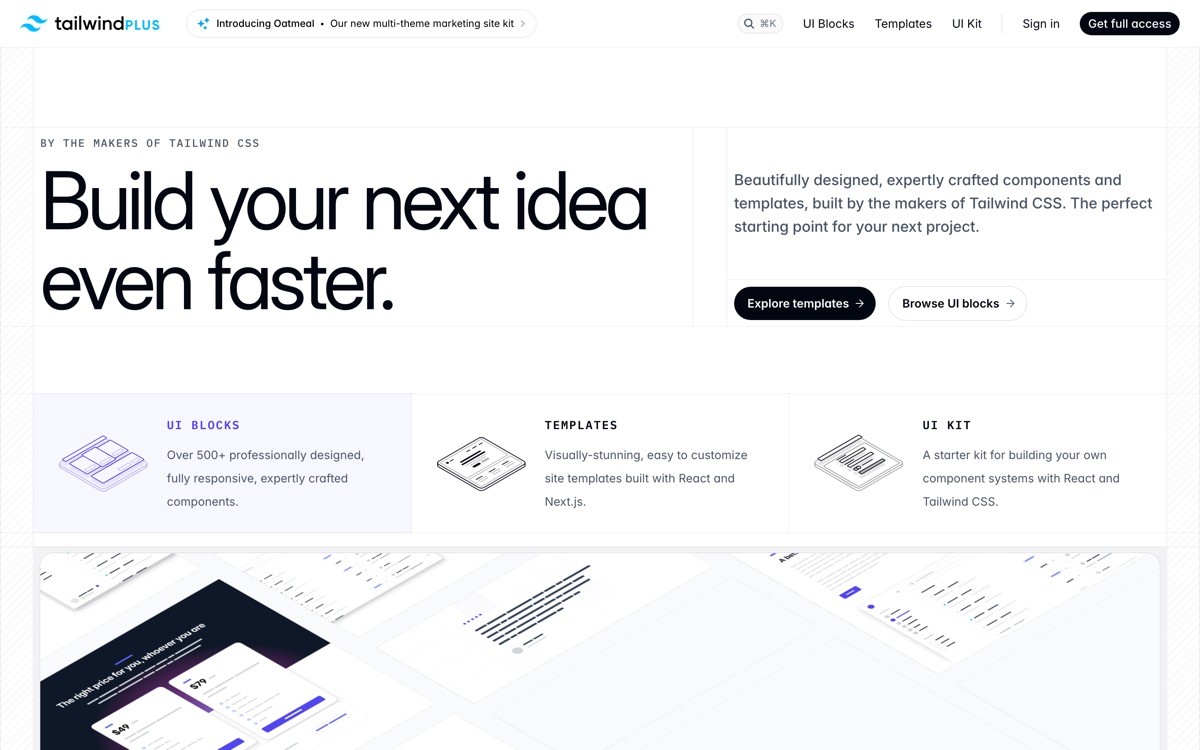
Tailwind UI is a premium component and template library from the team behind Tailwind CSS. It ships hundreds of components and full marketing, application, and ecommerce templates as production-ready HTML, React, and Vue code. For SaaS teams already using Tailwind, it is the closest thing to a default standard.
The value is not just code quality, which is consistently high, but the system. Tailwind UI components share a coherent design language, are accessible by default, and integrate cleanly into any Next.js or React app. Engineers can drop the code into a real product stack without the markup gymnastics required by most marketplace templates.
Key strengths
Production-grade HTML, React, and Vue components
Full marketing, app, and ecommerce templates included
Accessible by default, built by the Tailwind CSS team
Lifetime updates with one-time license
Catalyst, their application UI kit, adds dashboard components on top
Best for
Engineering-led SaaS teams already using Tailwind CSS
Startups shipping landing pages inside the same Next.js codebase as the app
Teams that want one component system covering marketing and product UI
Pricing
One-time license, typically several hundred dollars for personal use
Team licenses available at higher tiers
Includes lifetime updates and new components
Pros
Code quality is the gold standard in the Tailwind ecosystem
One license covers years of updates
Pairs naturally with shadcn/ui for product surfaces
Cons
Higher upfront cost than most marketplace templates
The visual style is widely recognized, so distinctive brands need extra customization
2. Cruip, best for React and Next.js SaaS startups
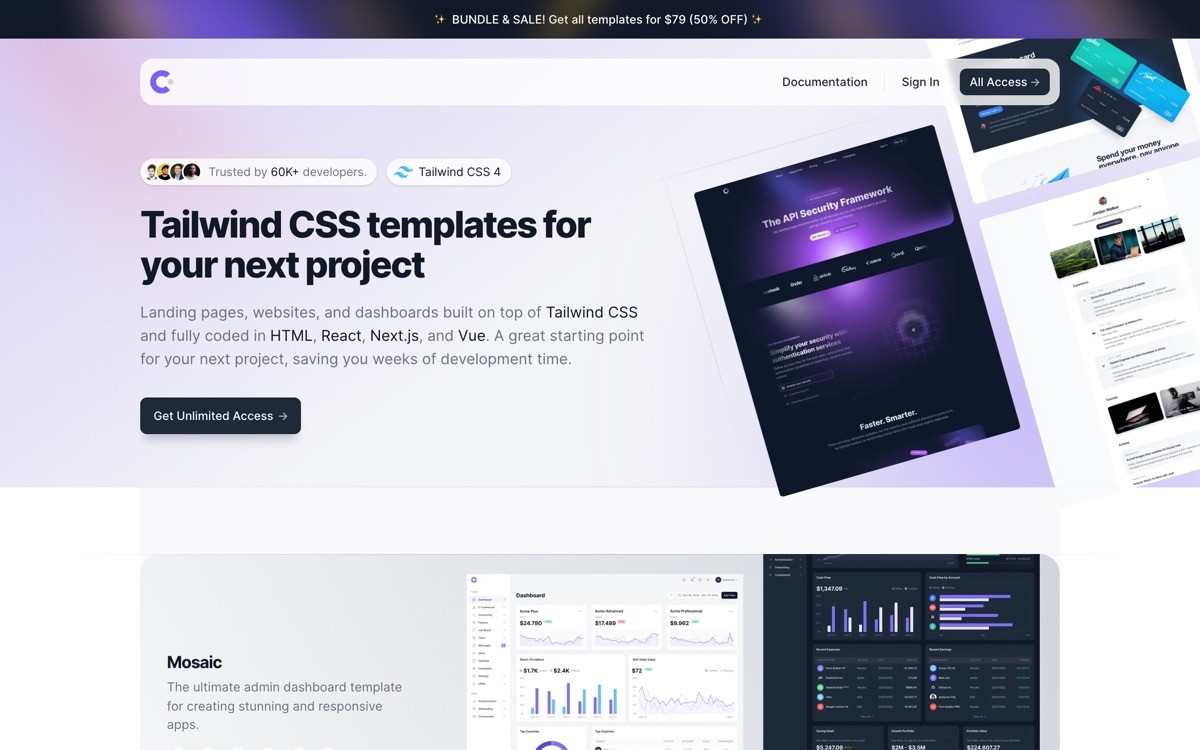
Cruip is a template studio that produces polished SaaS landing page templates in HTML, React, and Next.js with Tailwind CSS. Their catalog focuses heavily on AI startups, SaaS, and modern marketing sites, with patterns that match how funded startups present themselves in 2026.
The reason Cruip stands out for SaaS specifically is that the templates are not pure design exercises. They include real CTA structures, multi-section heroes, integration grids, pricing comparison patterns, and dark and light mode variants out of the box. The Next.js versions are clean enough to ship without a rebuild.
Key strengths
SaaS-focused catalog with modern patterns
React and Next.js versions on most templates
Tailwind CSS as the styling layer
Dark mode included as a first-class feature
Pricing comparison and integration sections built in
Best for
AI and SaaS startups using React or Next.js
Founders who want a polished, code-ready landing page in days
Teams that prefer single-template purchases over component subscriptions
Pricing
Individual templates typically $39 to $129 one time
Bundles and team licenses available
Pros
Right-sized for SaaS marketing pages
Code is clean and easy to integrate
Updates released for new design patterns
Cons
Visual style trends toward modern minimal, which can read as generic without customization
Some templates duplicate sections across the catalog
3. Tailwind Awesome, best discovery layer
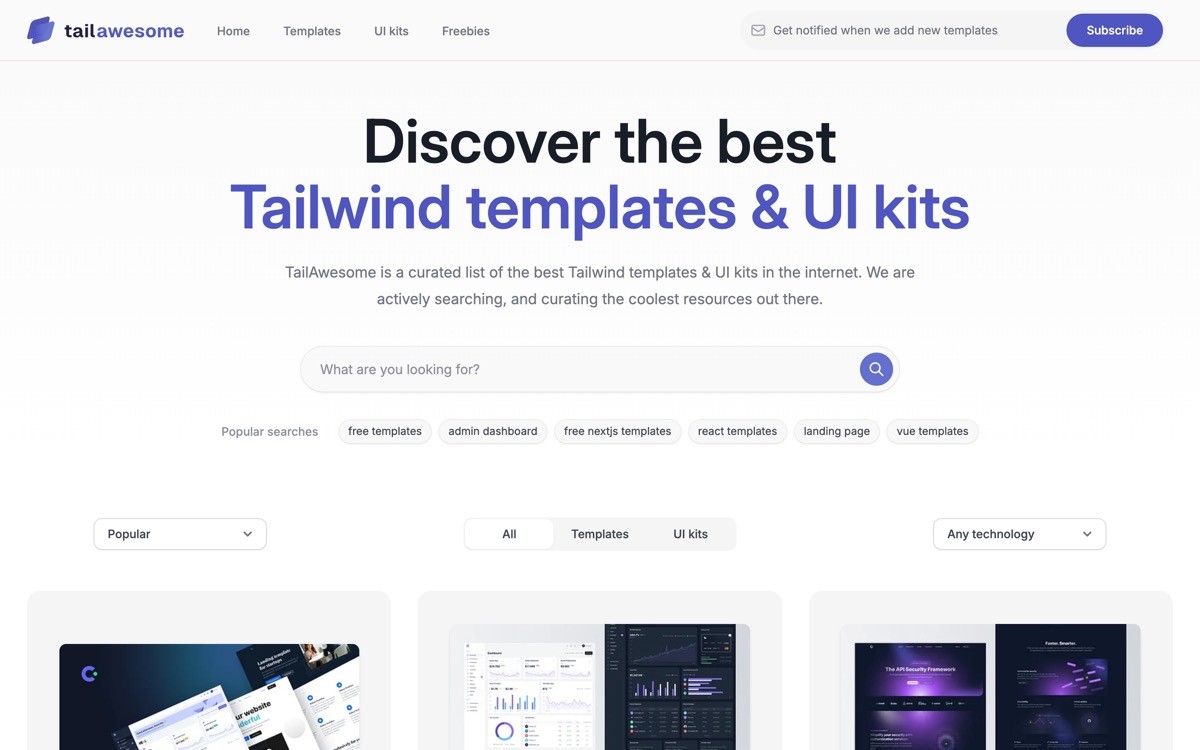
Tailwind Awesome is an aggregator that catalogs thousands of Tailwind CSS templates, components, and kits from across the ecosystem. It is not a template producer itself but the place to discover what is available across creators, price points, and frameworks.
For SaaS founders shopping for a Tailwind landing page, it removes the need to bookmark every individual creator's site. Filters by framework, price, and category help narrow the field. The trade-off is variance, you still need to vet individual creators before buying.
Key strengths
Aggregates thousands of Tailwind templates and components
Filters by framework, price, category
Surfaces niche creators alongside major studios
Free to browse, no subscription
Best for
Founders comparison shopping for the right Tailwind template
Teams that want to scan the full market before committing
Designers sourcing components for client projects
Pricing
Free to browse
Each listing links to the creator's own pricing
Pros
Saves time on market discovery
Reveals strong niche creators
Good way to find free templates before paying
Cons
Quality varies by creator, not curated
Listings can go stale if the creator's site moves
4. Wicked Templates, best mid-tier SaaS catalog
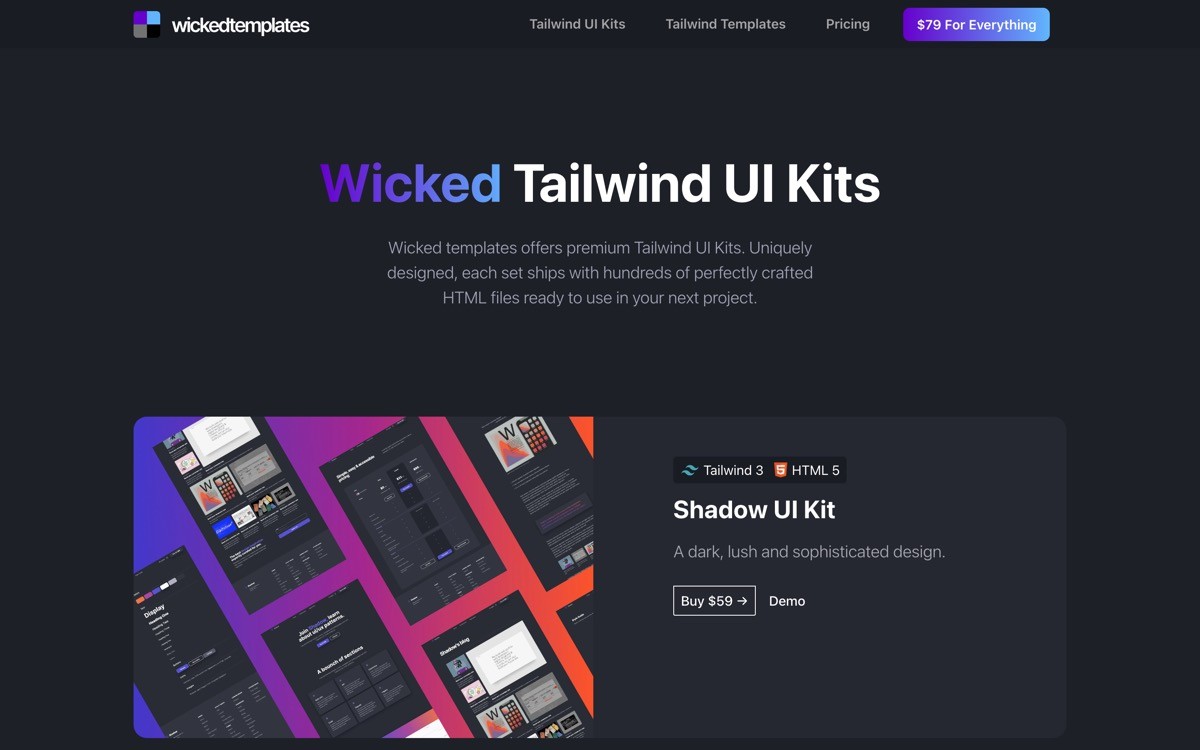
Wicked Templates is a curated marketplace that sells SaaS, startup, and AI landing page templates in HTML, Tailwind, and React. The catalog is smaller than ThemeForest but the curation bar is higher, with consistent visual quality and conversion-focused patterns.
For SaaS founders who want a polished template without paying Tailwind UI prices, Wicked Templates lands in the middle. The templates ship with multiple page variants (landing, pricing, blog, careers) so a v1 marketing site can be assembled from one purchase.
Key strengths
Curated catalog with consistent quality
Multiple page variants per template
Conversion-focused section patterns
HTML and Tailwind options
Lifetime access bundles available
Best for
Founders who want curated quality without enterprise pricing
Marketing teams that need a full multi-page template, not just a hero
Pricing
Single templates typically $49 to $99
Lifetime access bundles for unlimited template downloads
Pros
Right price band for early-stage SaaS
Multi-page variants reduce the need to buy a second template
Cons
Smaller catalog than larger marketplaces
Less framework breadth than Tailwind UI
5. ThemeForest, best widest catalog
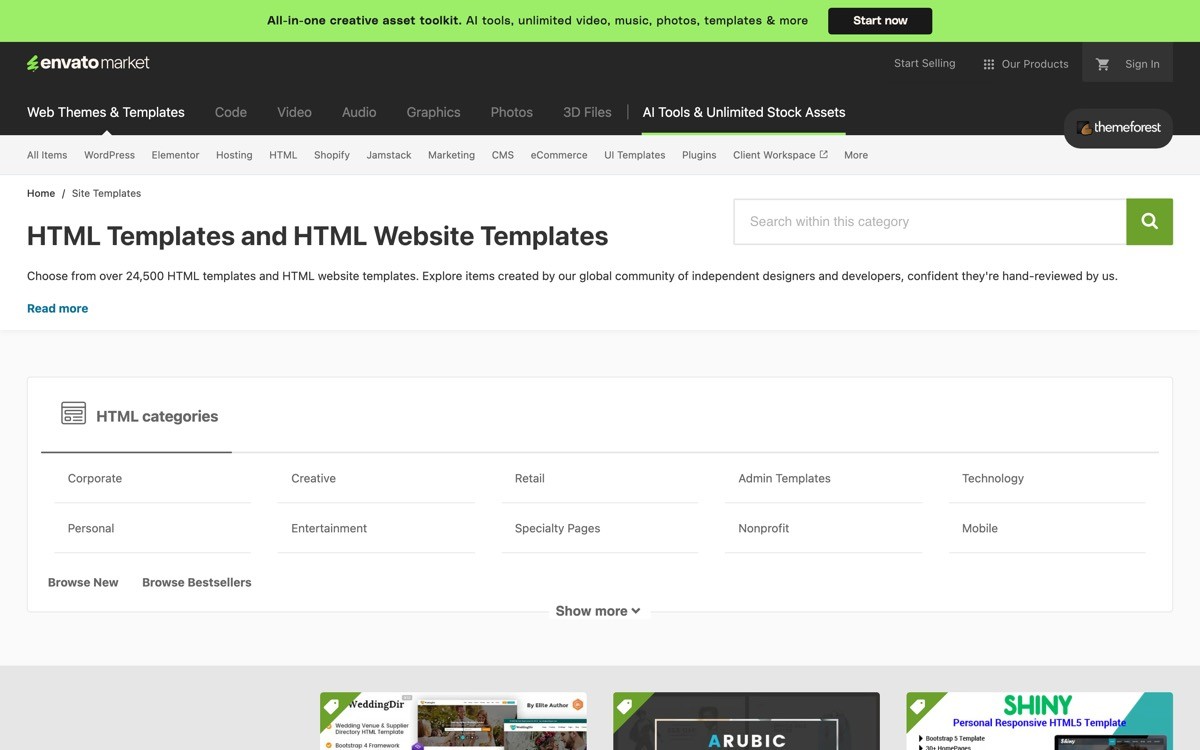
ThemeForest is the long-running Envato marketplace with the largest catalog of HTML, WordPress, and CMS landing page templates. It is the default place to look when you want options at any price point, especially under $50.
For SaaS founders, ThemeForest is the trade-off: you get range and price flexibility, but quality varies and many templates are dated. The realistic move is to filter aggressively by recent listings, high ratings, and SaaS-specific tags, then check the live demo carefully before buying.
Key strengths
Largest catalog of landing page templates online
Wide price range from $19 upwards
Filters for framework, recency, ratings
Live demos for every listing
Long-running platform with support flow
Best for
Founders shopping on tight budgets
Side projects and pre-revenue tests
WordPress-based SaaS marketing sites
Pricing
Most templates between $19 and $79 one time
Optional extended licenses for resale
Pros
Lowest price band of the kits listed here
Wide framework coverage including WordPress
Cons
Quality variance is significant
Many templates use outdated patterns
Heavy reliance on stock imagery in demos
6. Webpixels, best component library for marketers
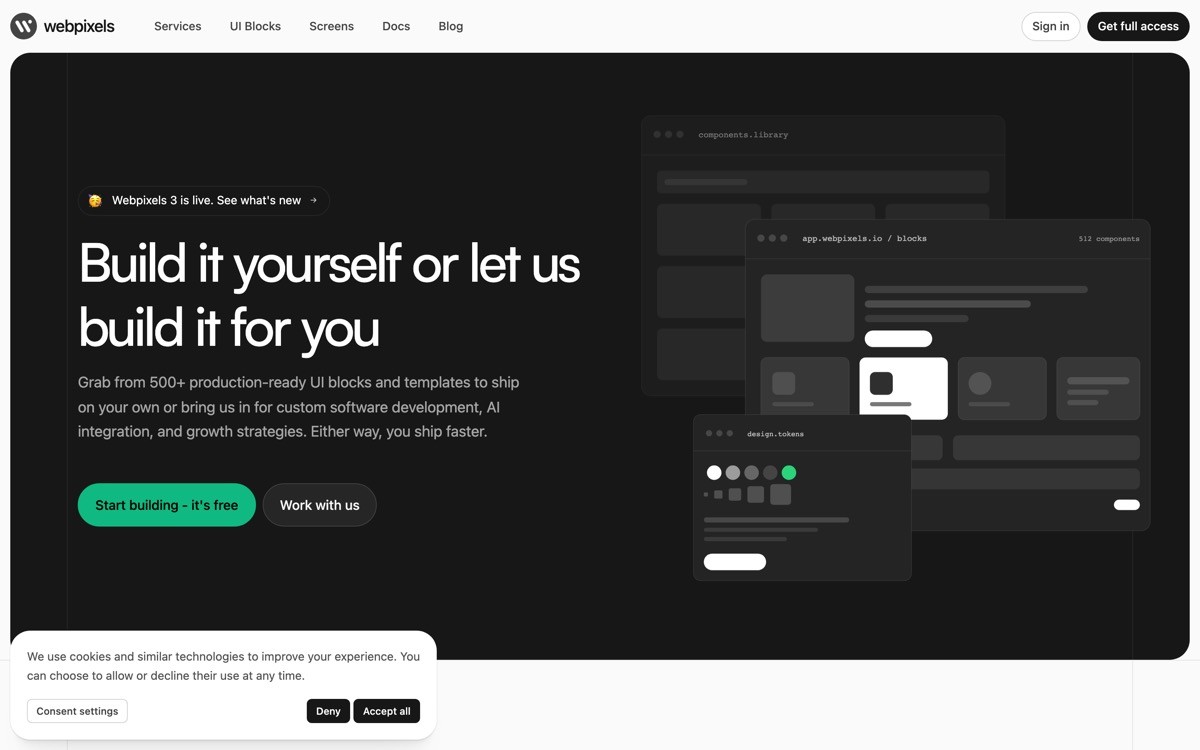
Webpixels is a component library and template studio focused on Bootstrap and Tailwind, with thousands of pre-built sections and full landing pages aimed at non-engineering marketers. It is built around HTML output that drops into any static site or CMS.
The strongest use case is for marketers shipping campaign pages, lead magnets, and ad landing pages who want a section library plus templates without needing a React dev. The free tier covers a wide range of components, and the Pro tier unlocks the full catalog.
Key strengths
Thousands of components across Bootstrap and Tailwind
Full landing page templates plus section libraries
Static HTML output, framework-agnostic
Free tier for early experimentation
Drag-and-drop sections for fast assembly
Best for
Marketing teams shipping campaign and ad landing pages
SaaS using Bootstrap as the styling layer
Non-engineering founders who want a section library
Pricing
Free starter with limited library access
Pro plans typically under $20 per month
Pros
Strong Bootstrap support, which is rare in modern template kits
Fast section assembly for high-volume page production
Cons
Bootstrap output requires more cleanup if your stack is Tailwind-only
Visual style is functional rather than distinctive
7. Framer Marketplace, best for design-led launches
Framer's marketplace is the right pick when the SaaS landing page does not need to live inside the React app and the priority is design quality and animation. Framer templates ship as full Framer projects, including animations, interactions, and responsive behavior, and they go live as a hosted Framer site.
For non-engineering founders, this is the lowest-friction path to a designed landing page that does not look templated. The trade-off is the platform lock-in: the site lives on Framer hosting and the team needs to know Framer to edit it.
Key strengths
Designed templates with animation and motion built in
Live on Framer hosting without engineering setup
Strong visual quality across the marketplace
Easy to edit copy and brand without code
Mobile responsive behavior tested in template
Best for
Non-engineering founders launching v1 marketing sites
Designers shipping client work fast
Teams that want design quality over framework flexibility
Pricing
Templates typically $49 to $199 one time
Framer hosting separate, plans from around $15 per month
Pros
Best out-of-the-box visual quality of the kits listed
No engineering required to publish
Cons
Locked into Framer as the hosting platform
Less flexible than code-based templates for unusual integrations
How to choose the best SaaS landing page template for your stack
1) Does the landing page live inside your product app?
If yes, choose a code-based template that matches your stack. For Next.js and React with Tailwind, Tailwind UI or Cruip. For WordPress, ThemeForest. Trying to integrate a Framer page or a static HTML template into a live Next.js app costs more than starting with the right kit.
2) Who is going to edit the page after launch?
If marketers will edit copy and add new pages without engineering, choose Framer or Webflow templates that they can update directly. If engineers control the page, Tailwind UI and Cruip stay flexible inside the codebase. Mismatching the editor and the stack creates a permanent bottleneck.
3) How much traffic and how many variants will you run?
If you run constant A/B tests and need many landing page variants for ads and campaigns, invest in a component library like Webpixels or Cruip's section catalog. A single fixed template will not scale to ten campaign-specific landing pages without becoming a copy-paste mess.
4) What does your real performance budget look like?
Code-based templates from Tailwind UI and Cruip are typically lighter than animation-heavy Framer templates. If Lighthouse scores matter for SEO and ads, factor that in. Framer pages can be optimized but require care.
5) What is the true total cost?
A $99 template is not the real cost. Add hosting, your engineering time to integrate, the designer time to brand it, and the rebuild cost if the template does not fit. Founders who only budget the template price usually end up replacing it within six months.
If you have picked your template but the conversion numbers are flat, the gap is usually positioning, hierarchy, and brand, not the template. AY Design takes templated SaaS landing pages and turns them into pages that actually convert, covering hero positioning, social proof, pricing layout, and the brand system on top. Book a design audit to see what to fix first.
FAQ
What is the best SaaS landing page template in 2026?
For most engineering-led SaaS teams in 2026, Tailwind UI is the best landing page template because of its code quality, full template coverage, and tight integration with the Tailwind CSS ecosystem. For React and Next.js startups that want a polished single-template purchase, Cruip is the next strongest pick.
How much should a SaaS landing page template cost?
Most SaaS landing page templates cost between $39 and $199 as a one-time purchase. Premium kits like Tailwind UI use a higher-priced license with lifetime updates, typically in the several-hundred-dollar range. Component subscriptions like Webpixels or Relume run on monthly plans starting under $20.
Should I use a code-based or visual SaaS landing page template?
If the landing page needs to live inside your product app or share code with the dashboard, choose a code-based template like Tailwind UI or Cruip. If the marketing site can live separately and non-engineering team members will edit it, Framer or Webflow templates are faster to ship and maintain.
Are SaaS landing page templates good for conversion?
Templates give you structure that is usually better than starting from scratch, but they do not guarantee conversion. The hero copy, positioning, social proof, and pricing layout still need to be designed for your specific audience. Most templates ship with placeholder copy that will not convert until it is replaced with real positioning.
What is the difference between Tailwind UI and shadcn/ui?
Tailwind UI is a premium component and template library focused on marketing and application UI, with a one-time license and lifetime updates. shadcn/ui is a free open-source collection of copy-and-paste React components built on Radix UI and Tailwind, focused on application UI. Many SaaS teams use Tailwind UI for marketing and shadcn/ui for the product.
Can I use a Framer template for a SaaS landing page?
Yes, Framer templates are well-suited to SaaS landing pages, especially for non-engineering founders who want a designed and animated page without writing code. The trade-off is hosting on Framer and learning the Framer editor to make updates. Many SaaS startups run their marketing site on Framer and their product on a separate stack.
Are free SaaS landing page templates good enough?
Free SaaS landing page templates are good enough for pre-revenue tests and validating a positioning hypothesis, but most lack the structural depth and component coverage you need at launch. The realistic move is to use a free template first to test, then upgrade to a paid template or a custom design once the funnel is working.
Do I need a designer if I use a SaaS landing page template?
If the template looks templated to you, it will look templated to prospects. A designer is what turns a template into a brand, fixes the hero positioning, and adjusts the section hierarchy for conversion. For SaaS startups that want a real conversion lift, a focused design pass on top of a clean template is usually the highest-ROI investment.
Checkout other Blogs:

Multi-agent system UX design guide for 2026
A pattern-by-pattern guide to designing multi-agent system UX in 2026, with a scoring matrix and references from Claude Code, LangGraph, Devin, and Replit Agent.
Author:
AY Designs Team
Human-in-the-loop AI design guide for 2026
A 2026 guide to human-in-the-loop AI design with patterns, scoring framework, and examples from Cursor, Claude Code, Stripe, and Notion AI.
Author:
AY Designs Team

How to design agentic AI products in 2026: a 7-step playbook
A seven-step design playbook for shipping agentic AI products that users actually trust, with scoring matrix and real product references from Cursor, Claude Code, Devin, and Perplexity.
Author:
AY Designs Team

How much does AI SaaS design cost in 2026?
AI SaaS design cost in 2026 by tier and engagement type, with ranges, timelines, and a value scorecard for founders shipping with Lovable, Bolt, and v0.
Author:
AY Designs Team