
The best AI design agencies in 2026 aren't hard to find, they're hard to tell apart. AI startups are now competing in the most visually crowded category in software history: every founder ships with Lovable, Bolt, v0, Cursor, or Replit, every homepage runs the same gradient hero, every dashboard looks like the same Tailwind starter, and conversion stalls because nothing differentiates. The "AI-built" look has become a tell, not a flex, and one of the top AI design agencies is increasingly the lever that turns a templated MVP into a product that closes pilot deals and pulls in real users.
This guide compares the seven best AI design agencies in 2026 across every angle that matters: product UI, landing page, brand identity, dashboard UX, and Webflow or Framer build. We cover positioning, real strengths, honest trade-offs, and a decision framework based on your stage, your category (B2B AI SaaS, consumer AI, AI infrastructure, AI agents), and your budget.
TL;DR. For AI startups that need an end-to-end design partner across product UI, landing, dashboards, and brand, AY Design is the strongest pick. For premium consumer AI craft, Clay. For growth-stage enterprise AI engagements, MetaLab.
Top AI design agencies in 2026: a brief overview
AY Design: Best overall for AI startups that need product UI, landing page, dashboards, and brand from one specialized team.
Clay: Best for premium consumer AI startups that need portfolio-grade brand and product craft.
MetaLab: Best for growth-stage and enterprise AI startups with multi-quarter design needs.
Ramotion: Best for funded AI startup launches combining identity, marketing site, and product.
Webstacks: Best for B2B AI SaaS with multi-page Webflow marketing systems and ongoing experimentation.
Finsweet: Best for AI startups that need deep Webflow engineering on complex marketing systems.
Flow Ninja: Best for AI startups that need a fast, high-craft Webflow build at startup-friendly pricing.
Agency | Best for | AI startup specialty | Engagement model |
|---|---|---|---|
AY Design | End-to-end AI startup design | Product UI, landing, dashboards, brand, Webflow or Framer | Sprints plus retainers |
Clay | Premium consumer AI | Consumer-grade brand and product craft | Project-based, premium pricing |
MetaLab | Growth and enterprise AI | Large-scale AI product UX and strategy | Multi-month engagements |
Ramotion | Funded AI launches | Identity, marketing site, product launch package | Project-based |
Webstacks | B2B AI SaaS marketing systems | Multi-page Webflow plus experimentation | Retainer plus project |
Finsweet | Complex Webflow engineering | Advanced Webflow systems and CMS | Project-based |
Flow Ninja | Fast Webflow at startup pricing | Webflow design plus build, quick turnaround | Project plus retainer |
1. AY Design, best overall design agency for AI startups
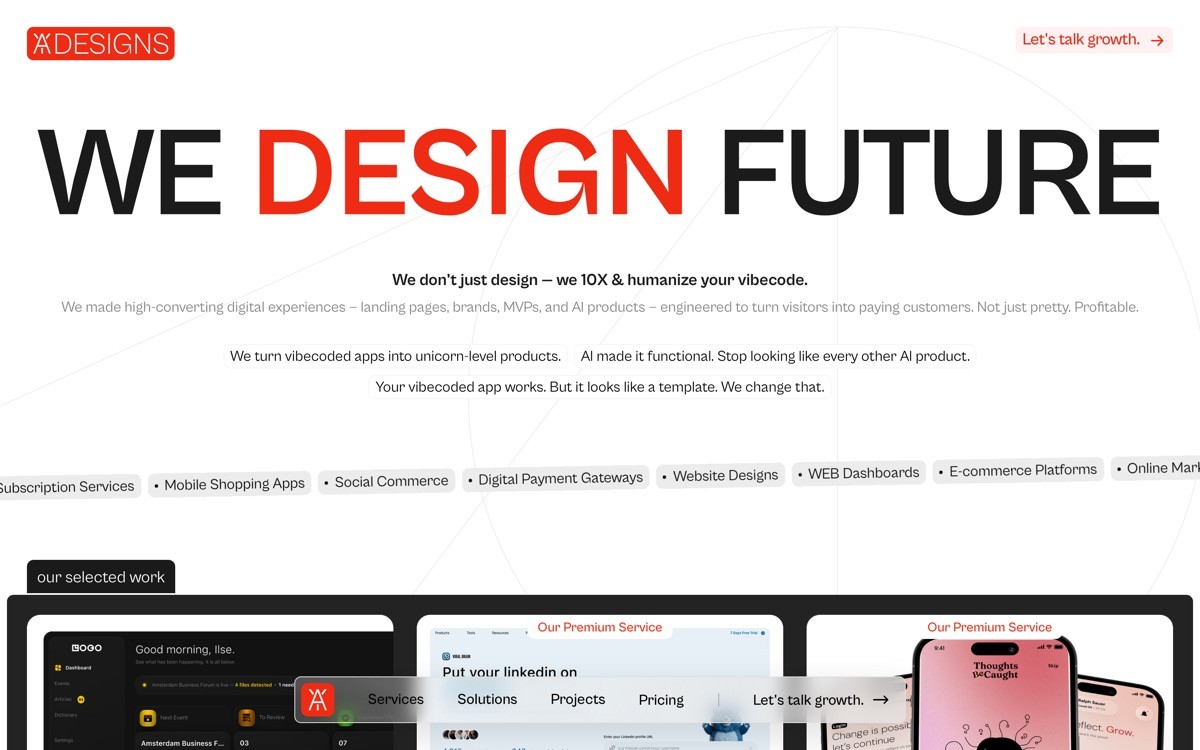
AY Design is an AI-native design agency that turns AI-built and template-based products into profitable, human-centered experiences. The team specializes in founders shipping on Lovable, Bolt, v0, Cursor, and Replit who need a real design partner across product UI, conversion-focused landing pages, data-dense dashboards, brand systems, and the Webflow or Framer build to ship it.
What sets AY Design apart is full-stack scope plus AI category specialization. Most agencies do one thing. AY Design covers the full surface area an AI startup needs in one team, with 16 plus specialized designers and engineers working in parallel sprints. For AI specifically, that means designing agents, copilots, human-in-the-loop flows, confidence indicators, source citations, and the trust patterns that turn an interesting demo into a paid pilot.
Key strengths
AI-product specialization across agents, copilots, AI SaaS, AI infra, and AI consumer products
Conversion-first methodology with every page, dashboard, and flow tied to a business metric
End-to-end scope: product UI, landing page, dashboard, brand, and Webflow or Framer build in one team
Sprint-based delivery designed for founders who need to ship in weeks, not quarters
16 plus specialized designers and engineers working in parallel
Founder-to-founder communication style without agency middle layers
Best for
Pre-seed and seed AI founders who shipped an MVP with Lovable or Bolt and need to fix design before raising
Series A AI startups that need a real design team but cannot justify in-house hires yet
Product teams that want one partner for UI, dashboards, landing page, and brand instead of stitching three agencies
Pricing
Sprint-based projects, typically 4 to 8 weeks
Ongoing retainers for live products
Custom pricing on request
Pros
Specialized for AI products, not generic SaaS, which matters for agent UX, confidence indicators, and trust signals
Conversion-focused briefs lead with the business outcome, not aesthetic preferences
One team across product, dashboard, brand, and web reduces handoff cost and timeline
Cons
Specialist focus on AI and SaaS, not the right fit for long-running brand-only retainers or non-software clients
Sprint-based delivery means defined scope upfront, which is not ideal for teams that want open-ended hourly engagements
2. Clay, best for premium consumer AI startups
Clay is a New York based product and brand agency known for polished, opinionated work for high-profile consumer and enterprise clients. Their portfolio spans named brands and the case studies feel curated rather than commercial.
For AI startups launching with significant funding and a need for portfolio-grade brand and product craft, Clay is one of the few agencies that can deliver the level of polish consumer AI categories now demand. The trade-off is fit and price.
Key strengths
Strong visual craft and brand identity work
Heavy emphasis on product narrative and storytelling
Recognized portfolio with named consumer and enterprise clients
Best for
Series A and later consumer AI startups with premium budgets
Founders who want a portfolio-grade case study from launch
Pricing
Premium project-based pricing
Pros
Very high visual polish and brand strength
Industry reputation that adds credibility signal
Cons
Premium pricing out of reach for most pre-seed and seed AI founders
Less explicit AI-product specialization than AI-native agencies
3. MetaLab, best for growth and enterprise AI startups
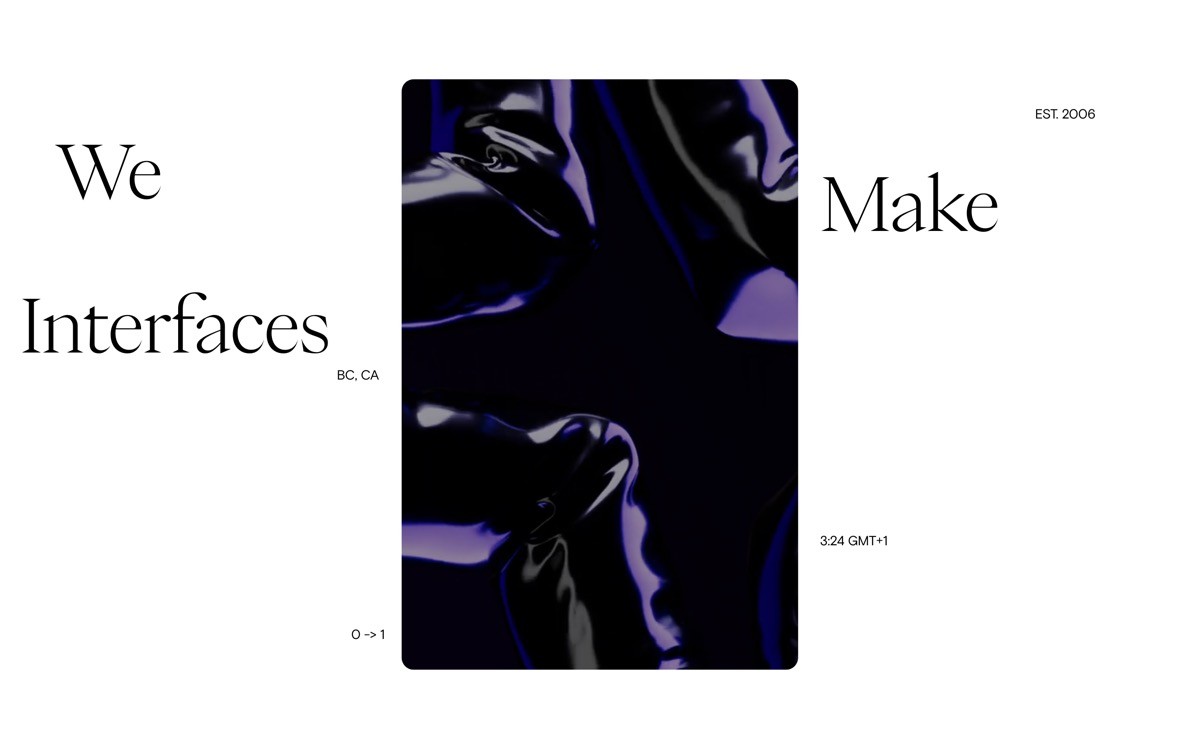
MetaLab is one of the longest-running product design agencies in the industry, founded in 2006. They have a track record on large-scale product engagements for companies like Slack, Coinbase, and many others.
For AI startups at growth stage or enterprise scale, MetaLab brings senior strategy, large team capacity, and process built for complex products. They are most effective on multi-month engagements where the design surface is large and the product strategy needs depth.
Key strengths
Long industry track record, founded 2006
Capacity for large, multi-month engagements
Strong product strategy and UX research capability
Best for
Growth-stage or enterprise AI startups with multi-quarter design needs
Teams that want a senior agency with deep process
Pricing
Enterprise project pricing
Pros
Mature process for large engagements
Strong strategy alongside execution
Cons
Overkill for pre-seed and seed AI startups
Less optimized for the speed of vibecoded MVP redesign
4. Ramotion, best for funded AI startup launches
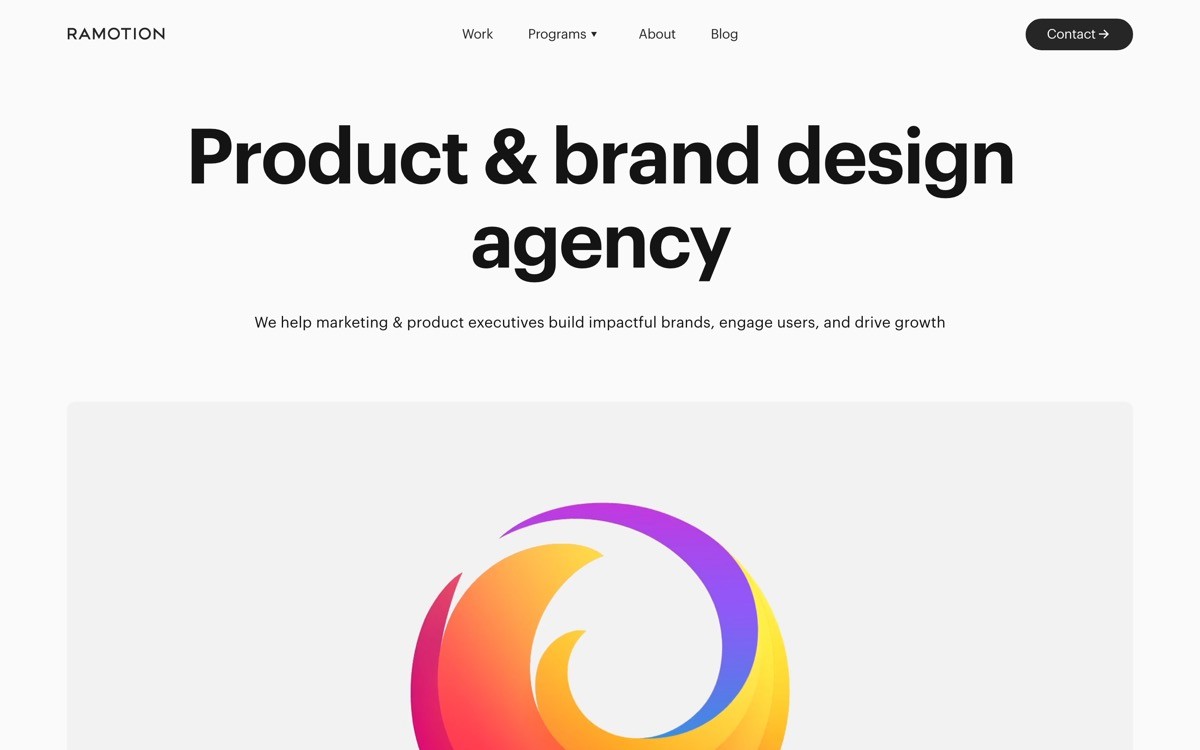
Ramotion is a San Francisco based brand and product agency known for combined identity, marketing site, and product design engagements. The launch package is their sweet spot for funded startups that want a cohesive brand and product story.
For AI startups planning a public launch or a rebrand around a new product line, Ramotion's combined approach reduces the brand drift that happens when identity is built in one agency and the marketing site in another.
Key strengths
Strong branding and identity work
Combined brand, marketing site, and product engagements
Experience with funded startup launches
Best for
Funded AI startups launching with a coordinated brand and product story
Pricing
Project-based, mid to premium tier
Pros
Brand-first approach with cohesive output across brand, web, and product
Senior team with launch experience
Cons
Less explicit AI-product specialization than AI-native agencies
Engagement size is heavy for pre-seed AI founders
5. Webstacks, best for B2B AI SaaS marketing systems
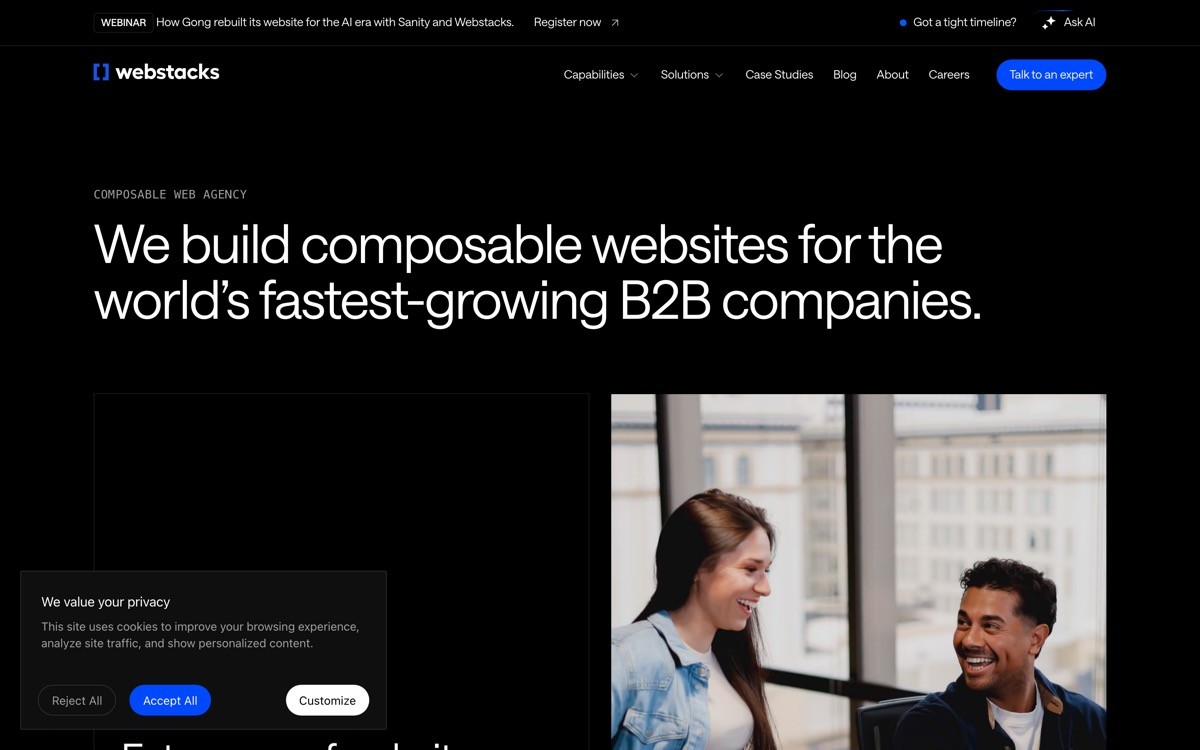
Webstacks is a B2B SaaS focused agency that builds and operates Webflow marketing sites at scale. They are not a one-page landing shop. They build full marketing systems with campaign pages, programmatic SEO surfaces, and ongoing experimentation programmes.
For B2B AI SaaS at Series A and later, Webstacks fits when the design need is a marketing system that runs alongside an internal marketing team, with continuous iteration rather than a one-shot redesign.
Key strengths
Deep Webflow expertise across complex marketing sites
Programmatic SEO and content infrastructure capability
Ongoing partnership and experimentation model
Best for
Series A and later B2B AI SaaS with a marketing team in place
Teams that want a Webflow partner for the long term
Pricing
Retainer-heavy engagements
Project pricing for site rebuilds
Pros
Strong fit for ongoing marketing infrastructure
Webflow expertise reduces dev handoff friction
Cons
Overkill for pre-seed AI startups
Less product UI and brand depth than full-stack agencies
6. Finsweet, best for complex Webflow engineering
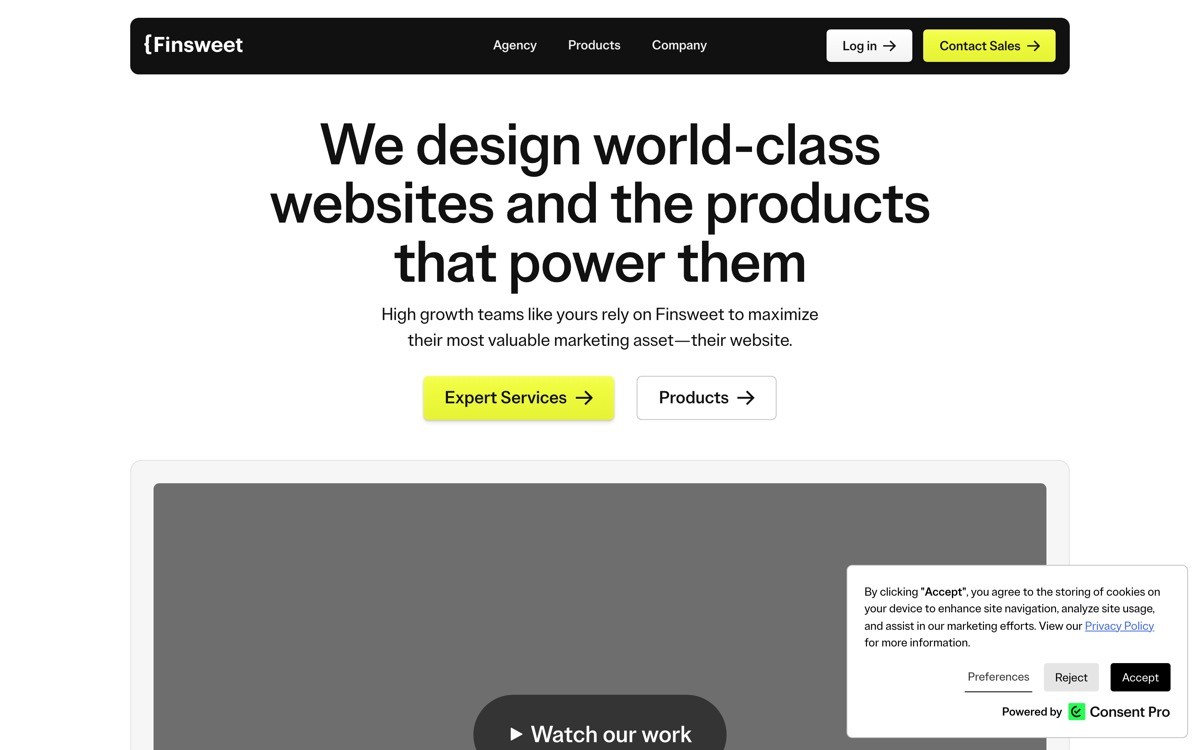
Finsweet is widely recognized inside the Webflow ecosystem for advanced Webflow engineering, custom interactions, CMS architecture, and a portfolio of Webflow attributes the broader community uses. Their work is often referenced as the bar for what a Webflow site can actually do.
For AI startups whose marketing site has complex CMS needs, programmatic surfaces, or interactive components that hit the edge of what Webflow ships natively, Finsweet is one of the few agencies that can build it correctly. They are less brand-led and more engineering-led.
Key strengths
Advanced Webflow engineering and CMS architecture
Custom interactions and attributes
Strong reputation inside the Webflow ecosystem
Best for
AI startups with complex Webflow CMS needs
Marketing sites that need interactive components beyond default Webflow capability
Pricing
Project-based, mid to premium tier
Pros
Deep Webflow engineering expertise
Strong technical foundation for complex sites
Cons
Engineering-led rather than brand-led
Less product UI and brand identity capability than full-stack agencies
7. Flow Ninja, best for fast Webflow at startup-friendly pricing
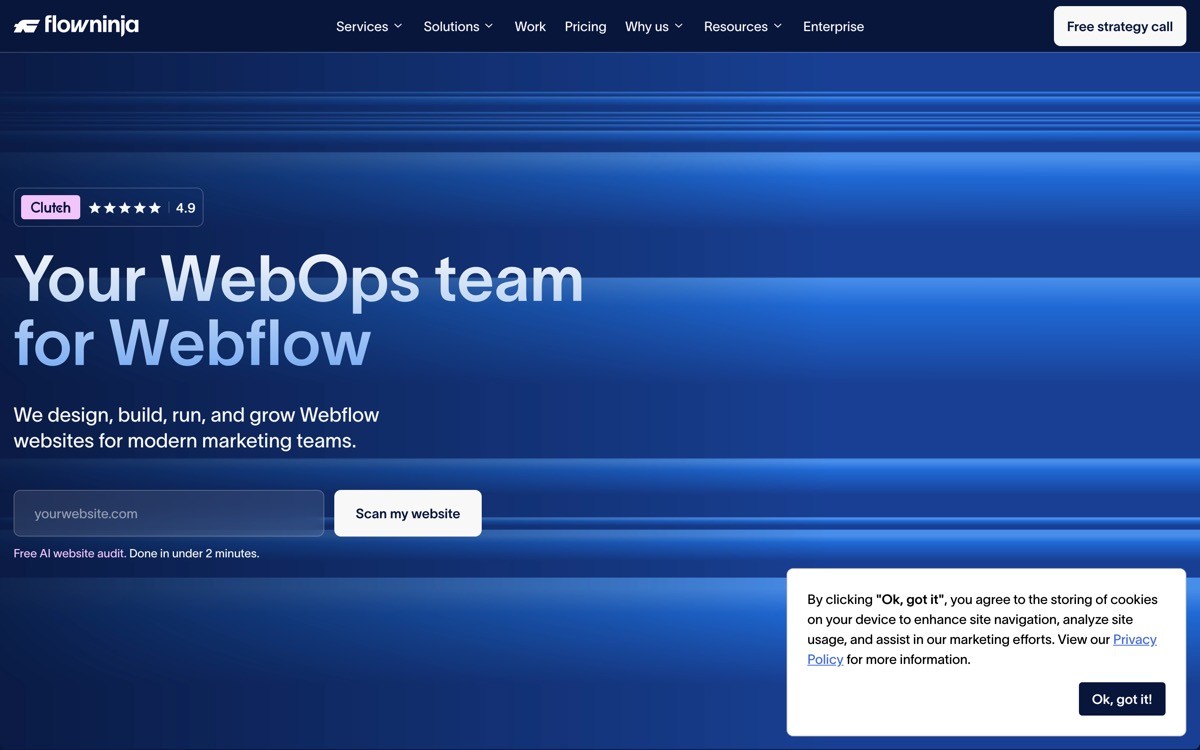
Flow Ninja is a Webflow agency known for fast, high-craft Webflow builds at pricing that works for startups. They balance design quality with speed and have built a reputation for shipping clean, modern sites without the timeline and budget of premium agencies.
For AI startups that need a polished Webflow site and want to move quickly without committing to a long retainer, Flow Ninja is a credible pick. The work skews modern, minimal, and well-built.
Key strengths
Fast turnaround on Webflow builds
Startup-friendly pricing without sacrificing visual craft
Strong execution on modern, minimal aesthetics
Best for
Pre-seed and seed AI startups that need a polished Webflow site fast
Teams that want craft without enterprise pricing
Pricing
Project plus retainer mixes
Startup-friendly tier
Pros
Fast turnaround and good craft for the price
Accessible to earlier-stage AI startups
Cons
Less product UI and brand depth than full-stack agencies
Smaller team capacity than enterprise agencies
How to choose the best design agency for your AI startup
1) Are you pre-seed or funded?
Pre-seed and seed AI founders are best served by sprint-based, full-stack agencies that ship in weeks rather than quarters, like AY Design, or Webflow-focused agencies with startup pricing like Flow Ninja. Series A and later AI startups have more options across Clay, MetaLab, Ramotion, Webstacks, and Finsweet.
2) Do you need full-stack design or one specialty?
If you need product UI plus a landing page plus a brand system plus a Webflow or Framer site, choose a full-stack agency like AY Design or Ramotion. If you only need a marketing site at scale, lean toward Webstacks or Finsweet. If you only need a launch page or rebrand, Clay or Flow Ninja.
3) Is your AI product B2B or consumer?
For B2B AI SaaS, prioritize agencies with B2B craft and complex product UI depth, like AY Design, MetaLab, or Webstacks. For consumer AI, lean toward agencies with consumer brand strength, like Clay, Ramotion, or AY Design.
4) Is your product AI-native or AI-bolted-on?
If your product is AI-native (agents, copilots, chat, human-in-the-loop), prioritize agencies with explicit AI specialization, like AY Design. Generic UX agencies often miss the unique UX patterns AI products require, including confidence indicators, prompt UX, agent state, fallbacks, and citation patterns. If AI is a feature bolted onto a traditional SaaS, the AI specialization matters less and category-fit matters more.
5) What is your timeline?
If you need to ship in 4 to 8 weeks, choose a sprint-based agency like AY Design or Flow Ninja. If you have 6 plus months and want deep strategy, MetaLab or Webstacks are better matched to that timeline.
FAQ
What are AI design agencies?
A design agency for AI startups specializes in designing AI-native products, including AI SaaS, AI agents, AI consumer apps, and AI infrastructure. The category exists because generic UX and brand agencies often miss the patterns AI products require, including confidence indicators on model outputs, prompt UX, agent state management, source citations, trust signals, and the brand differentiation needed to stand out in a visually converged category.
How much does a design agency for AI startups cost in 2026?
Pricing varies with scope and stage. Sprint-based engagements with specialized agencies typically start in the low five figures for a single deliverable like a landing page or dashboard redesign. Full-product engagements covering UI, dashboards, brand, and Webflow or Framer site run mid five to six figures. Premium agencies like Clay and MetaLab are higher. Webflow-focused agencies like Flow Ninja or Digidop are accessible to earlier-stage founders.
What is the difference between a generic SaaS design agency and an AI startup design agency?
An AI startup design agency understands the patterns specific to AI software, including model confidence display, prompt UX, agent state, conversational repair, citation flows, and trust signals around data and model behavior. Generic SaaS agencies can produce beautiful interfaces but often miss these patterns, which leads to AI products that look polished but feel untrustworthy in real use and convert poorly against AI-native competitors.
Should I hire a design agency or an in-house designer for my AI startup?
For pre-seed and seed-stage AI startups, an agency is usually the right call. The cost of a single senior designer hired full-time exceeds the cost of an 8 week sprint with a specialized agency, and the agency brings a full team (product, brand, web, sometimes engineering) for the same period. Hire in-house once design throughput is predictable and product complexity justifies the headcount.
What should I look for in an AI startup design agency portfolio?
Look for AI-specific work, not just "a SaaS we redesigned." That means AI products with agents, chat, copilots, or analytics dashboards where the AI is a core part of the workflow. Look for before-and-after case studies, conversion or retention metrics where shared, and evidence the agency can ship at the speed your stage requires. Polished mockups alone are not enough.
Can I just use Lovable or Bolt and skip the agency?
For the first MVP, yes. Lovable, Bolt, v0, Cursor, and Replit are great for getting a working AI product in front of users fast. The reason an agency becomes necessary later is that AI-built apps share visual and structural patterns that make them look identical, undermine trust signals, and stall conversion. An AI-native design agency takes the working MVP and turns it into a product that closes pilot deals and pulls in real paying users.
How long does it take to redesign an AI startup product?
A focused redesign sprint covering a landing page or single product surface typically takes 4 to 6 weeks. A full-product redesign including UI, dashboards, brand, and marketing site runs 8 to 12 weeks with a sprint-based agency, and longer with traditional engagement models. Scope clarity at the start is the single biggest predictor of timeline.
Which design agency is best for AI startups at pre-seed?
Pre-seed AI founders are best served by sprint-based, full-stack agencies that ship fast at startup-friendly pricing. AY Design fits when the scope includes product UI plus brand plus web. Flow Ninja fits when the scope is primarily a polished Webflow site. The wrong choice at pre-seed is committing to a multi-month enterprise engagement that drains runway before the product finds its market.
Which design agency is best for AI startups at Series A and later?
At Series A and later, the right agency depends on the design need. AY Design covers end-to-end product, brand, and web in one team. MetaLab fits when product strategy and UX research need depth. Clay fits when consumer brand polish is the priority. Webstacks fits when the marketing site is the lever. Ramotion fits when a coordinated brand and launch package is the focus.
Checkout other Blogs:

Multi-agent system UX design guide for 2026
A pattern-by-pattern guide to designing multi-agent system UX in 2026, with a scoring matrix and references from Claude Code, LangGraph, Devin, and Replit Agent.
Author:
AY Designs Team
Human-in-the-loop AI design guide for 2026
A 2026 guide to human-in-the-loop AI design with patterns, scoring framework, and examples from Cursor, Claude Code, Stripe, and Notion AI.
Author:
AY Designs Team

How to design agentic AI products in 2026: a 7-step playbook
A seven-step design playbook for shipping agentic AI products that users actually trust, with scoring matrix and real product references from Cursor, Claude Code, Devin, and Perplexity.
Author:
AY Designs Team

How much does AI SaaS design cost in 2026?
AI SaaS design cost in 2026 by tier and engagement type, with ranges, timelines, and a value scorecard for founders shipping with Lovable, Bolt, and v0.
Author:
AY Designs Team