
In 2026 the AI app builder market consolidated around three names. Lovable, Bolt, and v0 each took a different bet on what non-technical founders need most, and the differences now show up clearly in the kind of product you can ship in a weekend. Picking the wrong one for your stage costs you a month of rework when the first paying users arrive.
This guide compares Lovable vs Bolt vs v0 across seven decision dimensions that drive the real outcome: output type (full-stack vs frontend), design quality of the default output, backend and auth coverage, deploy and hosting, pricing for solo builders, code ownership and lock-in, and iteration speed. We focused on what each tool actually produces, not the marketing copy on the landing page.
TL;DR, for most non-technical founders in 2026 Lovable is the strongest end-to-end pick for shipping a real full-stack SaaS, Bolt is the fastest path to a working prototype the same day, and v0 is the best choice when frontend polish matters more than backend completeness.
Lovable vs Bolt vs v0: a brief overview
Output type: Lovable ships full-stack React apps with auth and database. Bolt ships full Node stacks running in the browser. v0 ships React and Tailwind frontends using shadcn components.
Design quality of default output: v0 wins by a clear margin because shadcn is its native vocabulary. Lovable has improved significantly; Bolt is the least design-led.
Backend and auth: Lovable wins through tight Supabase integration. Bolt can wire backend but takes more prompting. v0 is intentionally frontend-only.
Deploy and hosting: v0 deploys to Vercel in one click. Lovable hosts the app directly with a public URL. Bolt runs in the browser, deploys via Netlify or StackBlitz hosting.
Pricing for solo founders: All three have free tiers in 2026. Bolt's free tier is the most generous for daily prototyping. Lovable's paid plans are the best value for full-stack builders. v0 sits in the middle.
Code ownership and lock-in: Lovable syncs to your GitHub by default. v0 generates code you can copy or export. Bolt's WebContainer model makes export possible but less native.
Iteration speed: Bolt feels the fastest because the app runs as you build it. Lovable iterates conversationally with a live preview. v0 iterates per-component, which is fast for design and slower for assembled apps.
Criterion | Lovable | Bolt | v0 | Winner |
|---|---|---|---|---|
Output type | Full-stack React app | Full Node stack in browser | React and Tailwind frontend | Lovable for full-stack, v0 for frontend |
Design quality of default output | Strong, improved in 2026 | Functional, least design-led | Highest, shadcn native | v0 |
Backend and auth | Native Supabase integration | Prompted, doable | Frontend-only by design | Lovable |
Deploy and hosting | Hosted with public URL | StackBlitz, Netlify export | One-click Vercel deploy | Tie, depends on stack |
Pricing for solo founders | Best paid value for full-stack | Most generous free tier | Mid-range paid plans | Bolt for free, Lovable for paid |
Code ownership and lock-in | GitHub sync by default | Exportable, less native | Copy or export per component | Lovable |
Iteration speed | Conversational, live preview | Fastest, runs as you build | Per-component, fast for design | Bolt |
1. Output type and architecture
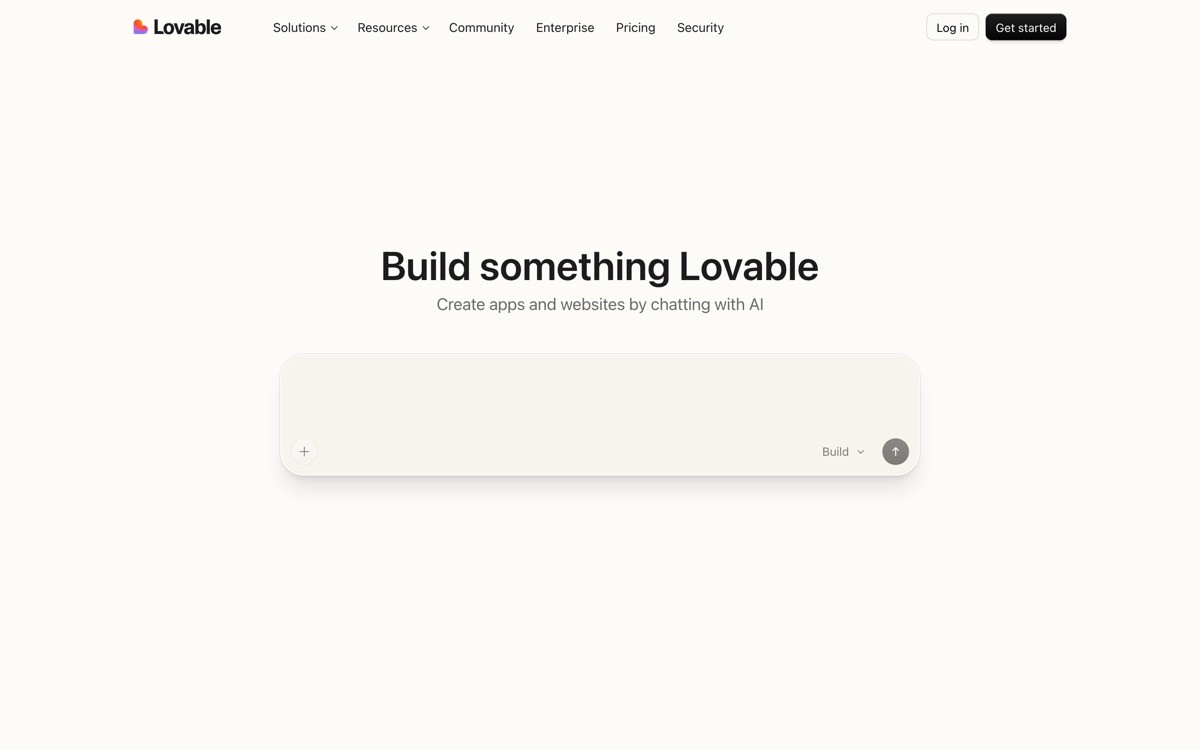
Output type is the single most important criterion because it defines what you can ship without a developer. The three tools sit on different points of the stack, and picking the right one starts with knowing what your product actually needs.
Lovable generates full-stack React applications with frontend, backend, authentication, and a database wired together by default. The output is a working web app, not a static prototype. As of 2026, Lovable's architecture maps cleanly to a real product: React frontend, Supabase backend, edge functions, and a public URL from day one.
Bolt runs full Node stacks in the browser via WebContainers. The output can be a frontend, a backend, or a full app depending on the prompt. The novelty is that everything runs live in the browser as you build, which makes the iteration loop feel different from anything else on this list.
v0 by Vercel is frontend-only by design. The output is React, Tailwind, and shadcn components, optimized for marketing pages, dashboards, and product UIs that connect to an existing backend. It is not the tool for shipping a complete SaaS in one go.
How each handles it
Lovable: full-stack React app with auth, database, and hosting
Bolt: full Node stack in the browser, flexible frontend or backend output
v0: React, Tailwind, shadcn components, frontend-only
Winner
Lovable wins for shipping a complete SaaS without code
v0 wins when you already have a backend and need polished frontend
Bolt is the most flexible across the stack but less opinionated
Recommendation
Building from zero to a paying customer: pick Lovable
Adding a polished surface to an existing backend: pick v0
Prototyping ideas across the stack daily: pick Bolt
2. Design quality of the default output
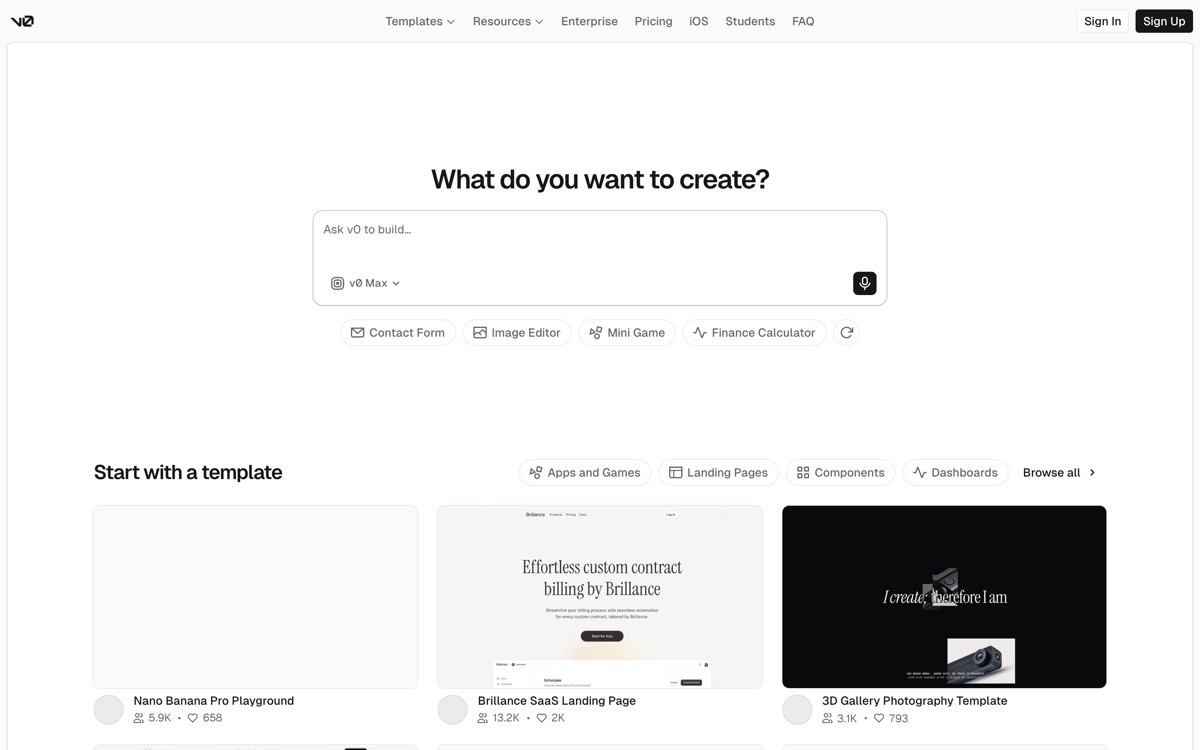
Design quality is the visual polish of the default output without manual cleanup. AI-built apps share a tell, and the tools that minimize that tell give you a head start on differentiation.
v0 ships the highest default design quality. shadcn/ui is the design system v0 was trained on, and the output uses modern Tailwind patterns, considered spacing, and components that look like a senior product designer made them. Of the three, v0 is the one whose output most often passes for hand-designed.
Lovable has improved significantly in 2026. The default output uses a refined Tailwind base and the gap with v0 has narrowed. There are still common Lovable tells (specific spacing patterns and component shapes) that a designer can spot, but a non-designer founder gets a credible product UI without fighting the tool.
Bolt is the least design-led of the three. The default output is functional but generic, with default Tailwind patterns and limited visual consideration. Bolt is the right pick for working prototypes and the wrong pick for a customer-facing surface without design polish on top.
How each handles it
v0: shadcn-native, modern Tailwind, senior-grade defaults
Lovable: refined Tailwind base, narrowed gap with v0
Bolt: functional, generic, design tells are obvious
Winner
v0 wins clearly for default design quality
Lovable is close enough for most non-designer founders
Bolt is fine for prototypes, not for customer-facing UI
Recommendation
If design polish matters to your first 100 users, use v0 for the customer-facing surface even if you ship the backend with Lovable
If you are pre-launch and validating, Bolt is fine; redesign before launch
3. Backend, auth, and database coverage
Backend coverage is whether the tool handles authentication, persistent data, edge functions, and the unglamorous wiring that turns a UI into a working product.
Lovable is the clear winner on backend. Its native Supabase integration handles auth, database, edge functions, row-level security, and storage out of the box. A founder can ship a multi-user SaaS with billing in days using only Lovable and Stripe.
Bolt can wire a backend but takes more prompting. The WebContainer can run a Node API server, you can connect to Supabase or any external service, and you can build a full-stack app. The catch is that it is not opinionated about how, so you carry more responsibility for architecture decisions.
v0 is intentionally frontend-only. To ship a working app you connect v0 output to an existing backend (Supabase, Convex, Vercel Postgres, or a custom API). For founders who already have a backend, this is a feature, not a limitation.
How each handles it
Lovable: native Supabase auth, database, edge functions, storage
Bolt: flexible Node stack, can wire any backend, less opinionated
v0: frontend only, connects to existing backends
Winner
Lovable wins for backend coverage out of the box
Bolt wins for backend flexibility
v0 wins for clean frontend that fits any backend
Recommendation
Pick Lovable if you want auth and data without thinking about it
Pick v0 if your backend is already in production
4. Deploy, hosting, and the path to a public URL
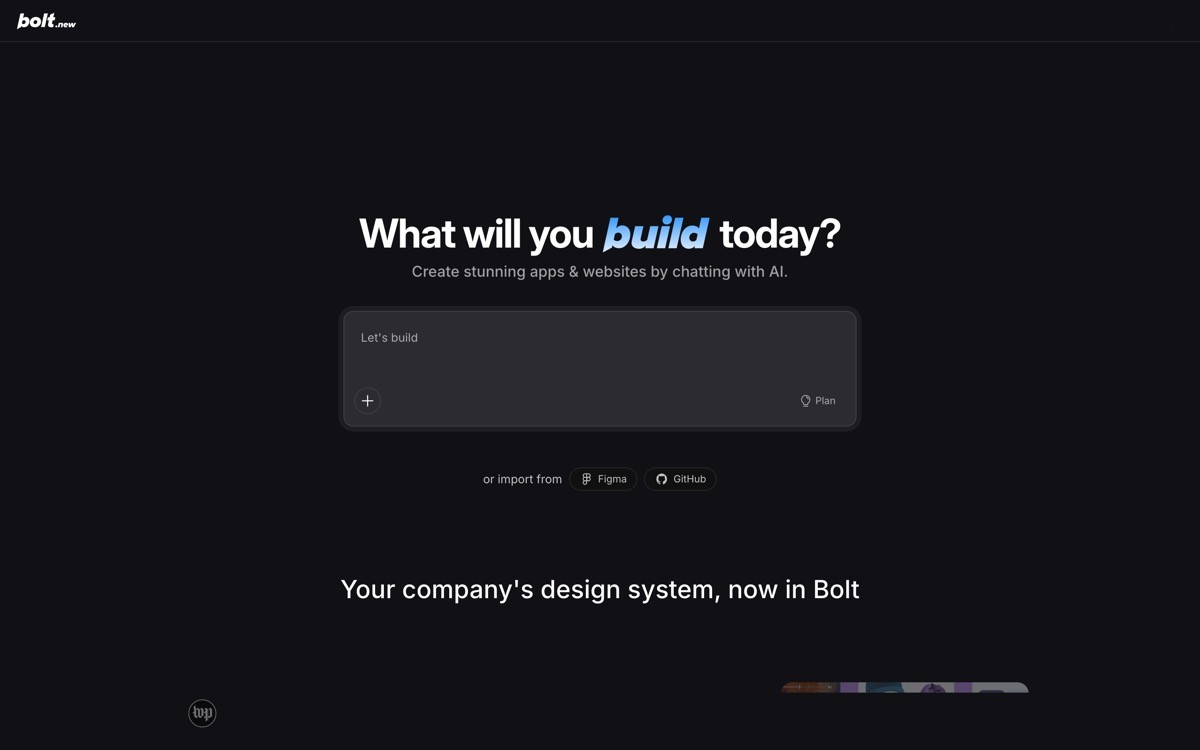
Deploy and hosting covers the friction between a working build and a public URL that real users can visit, including DNS, SSL, environment variables, and CI.
v0 deploys to Vercel in one click. Since v0 is a Vercel product, the integration is seamless: the generated project ships as a Vercel project with previews, production, and edge functions. Custom domains, SSL, and environment variables work the same as any other Vercel app.
Lovable hosts the app directly with a public URL out of the box. You can connect a custom domain on paid plans. The default hosted experience is friction-free; the trade-off is that the hosting model is opinionated, and serious production use often involves exporting to your own deployment target.
Bolt runs in the browser by default. To get a public URL you export the project and deploy via Netlify, Vercel, or StackBlitz hosting. The path is well documented but is one more step than the other two.
How each handles it
Lovable: hosted with public URL by default, custom domains on paid plans
Bolt: browser-first, export to Netlify, Vercel, or StackBlitz to deploy
v0: one-click Vercel deploy, full edge platform features
Winner
Roughly even between Lovable and v0 for friction
Bolt requires one extra step for production hosting
Recommendation
If you want a public URL immediately, Lovable or v0 deliver that in minutes
If you already use Vercel for everything, v0 fits the existing pipeline
5. Pricing for solo founders and indie builders
Pricing covers the realistic cost of building a product across the validation, launch, and early-traction phases. All three have free tiers in 2026; the differences show up at the paid level.
Bolt has the most generous free tier for daily prototyping. The free messages and runtime per day support real experimentation without immediately hitting a paywall. Paid plans add capacity and higher-quality models, with reasonable monthly prices for solo builders.
Lovable's paid plans are the best value for full-stack builders shipping real products. The included message volume on paid plans supports continuous iteration on a real SaaS, and the Supabase integration means you are not paying for the backend separately at small scale.
v0 sits in the middle. The free tier is enough for occasional component generation; serious daily use needs the paid plan. v0 is bundled with Vercel Pro, which makes it more cost-efficient if you are already a Vercel customer.
How each handles it
Lovable: tiered paid plans with message-based limits, best value for full-stack work
Bolt: most generous free tier, paid plans for higher capacity
v0: free for occasional use, bundled into Vercel Pro for daily use
Winner
Bolt wins for free-tier-heavy prototyping
Lovable wins for paid value when shipping a real SaaS
v0 wins for Vercel-native teams
Recommendation
Start on Bolt's free tier to prototype across the stack
Move to Lovable paid when shipping a real product
Use v0 alongside either tool when frontend polish is the bottleneck
6. Code ownership and lock-in
Code ownership is whether you can take the generated code with you and what the migration path looks like if you outgrow the tool or want a developer to extend it.
Lovable syncs the project to your GitHub by default. The code is yours, the repo is yours, and a developer can clone, extend, and deploy independently of Lovable. This is the cleanest ownership story of the three and matters a lot once a developer joins the team.
v0 generates code you can copy directly into your project or export to a Vercel project. There is no lock-in because the output is standard React, Tailwind, and shadcn. Migration is effectively free.
Bolt's WebContainer model holds the runtime in the browser, which is great for iteration but a little less clean for export. The code is exportable to GitHub or Vercel, but the workflow has one more step than Lovable's native GitHub sync.
How each handles it
Lovable: native GitHub sync, code is yours
Bolt: exportable to GitHub, Vercel, Netlify
v0: copy-out or export, no lock-in
Winner
Lovable wins for native ownership workflow
v0 wins for zero lock-in by design
Bolt is exportable but with one extra step
Recommendation
If you plan to hand the project to a developer within months, Lovable's GitHub sync is the smoothest handoff
v0 is the safest pick for teams who want zero platform dependency
7. Iteration speed and feedback loop
Iteration speed covers how fast you go from a change in your head to seeing it live in the product. For founders shipping with paying users, this drives weekly velocity more than anything else.
Bolt feels the fastest because the app runs in the browser as you build it. The feedback loop is immediate: change the prompt, watch the app reload, decide the next prompt. There is no deploy step, no preview lag, no hosting layer to wait on.
Lovable iterates conversationally with a live preview that updates as you prompt. The loop is fast but slightly slower than Bolt because changes go through the hosted environment. The trade-off is that you stay closer to a real production deployment, which matters as the product grows.
v0 iterates per-component. A new component generates in seconds, but assembling many components into a working app is more manual. For design iteration on individual surfaces, v0 is the fastest; for whole-app iteration, the other two pull ahead.
How each handles it
Lovable: conversational, live preview, hosted environment
Bolt: in-browser runtime, fastest feedback loop
v0: per-component generation, fast for design surfaces
Winner
Bolt wins for whole-app iteration speed
v0 wins for per-component design iteration
Lovable is the best mix of speed and production-readiness
Recommendation
If you ship daily to paying users, Lovable's speed plus stability is the best balance
If you are exploring ideas, Bolt's loop is hard to beat
How to choose between Lovable, Bolt, and v0 for your stage
1) Are you shipping a complete product or extending an existing one?
If you are building from zero to a paying SaaS, Lovable's full-stack output covers more ground in fewer prompts. If you have a backend and need a polished UI on top, v0's frontend-only model is more efficient. Bolt sits between, flexible across the stack.
2) How important is design polish for your first 100 users?
If the customer-facing surface needs to feel hand-designed from day one, ship the frontend with v0 even if you build the backend elsewhere. If you can redesign post-launch, Lovable's default output is enough to validate. Bolt is fine for prototypes, not for customer-facing UI at launch.
3) Are you optimizing for free-tier exploration or paid production work?
Bolt's free tier supports the most daily exploration without hitting limits. Lovable's paid plans give the best value once you are shipping real product work. v0 is most cost-efficient when bundled with Vercel Pro for teams already on Vercel.
4) When will a developer take over the codebase?
If a developer is joining within months, Lovable's GitHub sync is the cleanest handoff. v0's standard React output is also developer-friendly. Plan the handoff before you accumulate prompts on a stack the developer cannot easily inherit.
If you've picked your AI app builder but want a design partner to turn the output into a profitable, human-grade product that does not look AI-built, that's what AY Design does. We help founders ship Lovable, Bolt, and v0 builds that convert, with landing pages, dashboards, and brand systems built for real users. Book a design audit to see what to fix first.
FAQ
Is Lovable better than Bolt and v0 in 2026?
Lovable is the best end-to-end AI app builder in 2026 for non-technical founders shipping a real SaaS, because it ships a full-stack React app with auth, database, and hosting by default. Bolt is faster for daily prototyping and v0 is better for frontend polish, but neither covers the same end-to-end scope.
What is the difference between Lovable and v0?
The main difference between Lovable and v0 is scope. Lovable generates full-stack React apps with backend, authentication, and database, while v0 is frontend-only and generates React, Tailwind, and shadcn components. Pick Lovable to ship a complete SaaS; pick v0 to add polished UI to an existing backend.
What is the difference between Bolt and Lovable?
The main difference between Bolt and Lovable is the architecture and iteration model. Bolt runs the full Node stack in the browser via WebContainers and feels fastest for prototyping. Lovable ships a hosted full-stack app with native Supabase integration and is the better pick for production use.
Which AI app builder is best for non-technical founders?
Lovable is the best AI app builder for non-technical founders in 2026 because it covers frontend, backend, auth, database, and hosting in one tool. Bolt is the fastest for daily prototyping and v0 is the best for design polish; Lovable is the most complete for shipping a real product without a developer.
Can I switch from Bolt to Lovable or v0 later?
You can switch from Bolt to Lovable or v0 because all three output standard React code that can be exported. The migration is not automatic; you typically rebuild the app in the new tool while reusing the same backend, design assets, and content. Plan the switch before you accumulate too much prompt history on the wrong tool.
Is v0 free?
v0 has a free tier sufficient for occasional component generation in 2026, and is bundled with Vercel Pro for daily use. Heavier usage requires a paid v0 plan or Vercel Pro membership. The pricing model rewards teams already on Vercel.
Which AI app builder is best for designers?
v0 is the best AI app builder for designers in 2026 because the output uses shadcn/ui and modern Tailwind patterns out of the box. The default visual quality is the highest of the three, and the per-component generation model fits how designers think about UI surfaces.
Can Lovable handle production SaaS apps?
Yes, Lovable can handle production SaaS apps in 2026 thanks to native Supabase integration, GitHub sync, and the option to export and host the code on your own infrastructure. As traffic grows, most teams pair Lovable with a developer to extend the codebase, but the foundation is production-grade.
Checkout other Blogs:

Multi-agent system UX design guide for 2026
A pattern-by-pattern guide to designing multi-agent system UX in 2026, with a scoring matrix and references from Claude Code, LangGraph, Devin, and Replit Agent.
Author:
AY Designs Team
Human-in-the-loop AI design guide for 2026
A 2026 guide to human-in-the-loop AI design with patterns, scoring framework, and examples from Cursor, Claude Code, Stripe, and Notion AI.
Author:
AY Designs Team

How to design agentic AI products in 2026: a 7-step playbook
A seven-step design playbook for shipping agentic AI products that users actually trust, with scoring matrix and real product references from Cursor, Claude Code, Devin, and Perplexity.
Author:
AY Designs Team

How much does AI SaaS design cost in 2026?
AI SaaS design cost in 2026 by tier and engagement type, with ranges, timelines, and a value scorecard for founders shipping with Lovable, Bolt, and v0.
Author:
AY Designs Team